
 iscover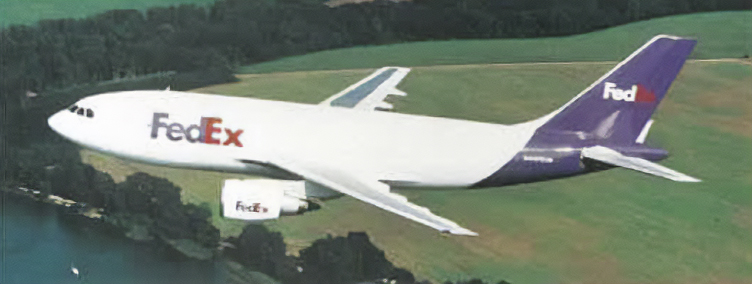
All's quiet on the small widebody twin front. Airbus's A310
Widebody Airliner Developments
 0 comment


Action at the Big End of Town: Widebody Developments
Boeing and Airbus are both pursuing radical developments of their widebody ranges: if all the plans eventuate, we will have two new versions of the 747 (one of them stretched to seat 550), a shorter 777, a shorter A330, a longer A340, a longer-ranged A340 and a lighter A310. At the top of the narrowbody market, Boeing is even talking of stretching the 757. Ever since the DC-4 and its cylindrical fuselage, the development of new airliner versions has usually involved beefier wings with bigger powerplants to lift more weight, which is then spent on longer fuselages or more fuel. Sometimes fuselages are cut to make the same wings and engines lift more fuel and thus increasing range. Most of the current developments involve such changes.
Bigger 747s
Boeing always had the option of torpedoing a new very large airliner by stretching the 747, and that is exactly what it looks like it will do. The result might not be the most technically efficient solution but almost certainly will be the most economically efficient one. The big effort will go into creating an entirely new wing and centre fuselage structure to lift heavier weights than the 395 tonne maximum takeoff weight of the 747-400. This is a very important change and might justify a new model number, but Boeing looks like selling its work as two new variants of the model 747. In one new variant, the 747-600, the beefier structure will lift a longer fuselage with unchanged range, while in the other, the unstretched 747-500, it will lift more fuel and consequently fly further. Both new versions would have much greater span (about 80m, compared with 64.3m in the -400) and a colossal maximum takeoff weight somewhere above 450 tonnes. The -600 would be 16m longer than the -400 at about 86m, which would give room for 550 passengers. Maximum range would remain about 13,600km (7350nm). The new fuselage centre section would make the -500 slightly longer but the passenger capacity would vary little from the 430 in the -400. Range, however, would rise to around 14,800km (8000nm), helping to see off competition from the new A340-8000, described below. An important economic factor in the enlarged 747 concept is the availability of engines; the A330 and 777 programs have already pushed the engine makers up into higher thrusts. Simple extrapolation from the 747-400 suggests a 450t aircraft would need something around 67,000lb (300kN) thrust per engine, which is comfortably within the range already running on A330s and 777s. Weight growth usually demands more than proportional rises in thrust, but engines up to 90,000lb (400kN) are already available, so no conceivable 747 version would need new engine development. Boeing could go for much higher weights than 450 tonnes if the airframe could stand it. Boeing says the new versions (called -500X and -600X for the moment) might but probably won’t be launched this year. The first would be in service in 2000 or 2001. The -600 would probably come first, since there is already one enthusiastic prospect: British Airways trying to get more people into and out of Heathrow.
This content is available exclusively to Australian Aviation members.
A monthly membership is only $5.99 or save with our annual plans.
- Australian Aviation quarterly print & digital magazines
- Access to In Focus reports every month on our website
- Unlimited access to all Australian Aviation digital content
- Access to the Australian Aviation app
- Australian Aviation quarterly print & digital magazines
- Access to In Focus reports every month on our website
- Access to our Behind the Lens photo galleries and other exclusive content
- Daily news updates via our email bulletin
- Unlimited access to all Australian Aviation digital content
- Access to the Australian Aviation app
- Australian Aviation quarterly print & digital magazines
- Access to In Focus reports every month on our website
- Access to our Behind the Lens photo galleries and other exclusive content
- Daily news updates via our email bulletin
Want to see more stories from trusted news sources?
Make Australian Aviation a preferred news source on Google.
Click here to add Australian Aviation as a preferred news source.