
 iscover

Despite its problems, the MB-339 has been an effective and popular replacement for the Strikemaster. (RNZAF)
More RNZAF Macchis Returning to Service
 0 comment


More Kiwi Aermacchi MB-339CBs to Fly in 1996
In February 1996, only eight to 10 of the Royal New Zealand Air Force’s 17 Aermacchi MB-339CB advanced jet trainers were flying. Of this number, six or seven were typically available for daily operations – more than for many months previously. Further steady work during 1996 is expected to bring more back into service after a difficult teething period that has been characterised by reduced availability and severe disruptions to pilot training.
More Kiwi Aermacchi MB-339CBs to Fly in 1996
With the advanced Aermacchi MB-339FD variant being one of three types under consideration for the RAAF’s Lead in Fighter, the New Zealand experience is clearly going to attract a good deal of attention. Although the FD contender differs significantly in detail from the RNZAF’s CB model, it will share the Rolls-Royce Viper 680-43 engine which has been causing the RNZAF so many headaches in recent years. The latest problems to afflict the RNZAF’s Macchis surfaced in early 1995, when cracks were found during routine maintenance in zero and first stage compressor blades of several of the 680-43 engines. The cracks were invisible to the naked eye and detectable only through use of specialist test equipment. A 300 hour restriction was imposed on engine life until the problem could be identified and cured. Since then, the RNZAF and Rolls-Royce have discovered that the cracks were the result of high crushing stresses in the blade/disk interface. Rolls-Royce is currently redesigning the interface; work is well advanced but when it will be completed is unclear — there are evidently delays and some areas of dispute. As an interim solution, Rolls-Royce has removed a sermetal coating from the base of the blades to reduce crushing stresses and provide a 200 hour life ‘Improved Standard’ compressor blade. All RNZAF aircraft will be operating with improved standard blades by the end of May this year. In service, the Air Force expects to extend the announced 200 hour life – a very conservative figure — if experience proves it is safe to do so. A further initiative designed to help overcome some of the RNZAF’s current problems is a logistics support review. A team led by Squadron Leader Barry Lennox is looking at current Macchi support processes, documenting current support problems, and also looking at alternative options for component repair. Alternative supply sources for some critical or ‘vulnerable’ components will be investigated, and the adequacy of current spares holdings will also be reviewed, along with Current Operational Level Maintenance and Phase Maintenance planning and work practices. A report was expected by the end of March 1996 and the Air Force hopes that the result will further improve in-house maintenance capabilities, and with that aircraft availability. Air Vice Marshal Carey Adamson summed up these promising developments as “cause for optimism”.
This content is available exclusively to Australian Aviation members.
A monthly membership is only $5.99 or save with our annual plans.
- Australian Aviation quarterly print & digital magazines
- Access to In Focus reports every month on our website
- Unlimited access to all Australian Aviation digital content
- Access to the Australian Aviation app
- Australian Aviation quarterly print & digital magazines
- Access to In Focus reports every month on our website
- Access to our Behind the Lens photo galleries and other exclusive content
- Daily news updates via our email bulletin
None of this was anticipated in 1991 when the first three of 18 Macchis were delivered to replace ageing BAC Strikemasters of No 14 Squadron based at RNZAF Ohakea. Operated by the Pilot Training School (PTS) and known as the Macchi Flight, the Macchis provide the advance phase of pilot training for the Air Force. Students receive 87.9 hours dual instruction on the Macchi, followed by 23.4 hours solo consolidation, 3.7 hours mutual consolidation — flown with another student — and a further 24 hours on the Macchi simulator. Skills taught on the Macchi, apart from general handling, include advanced aerobatics, normal and inverted spinning, instrument flying, formation flying, and high and low level navigation as well as mission orientation sorties and air-to-ground weapons delivery. Pilots have found the aircraft to be very ‘slippery’ — it flies with much less air resistance than the old Strikemasters, which were called ‘Blunty’ for good reasons. Performance is markedly greater. At 50% fuel and maximum stores the Aermacchi has an on-paper ability to pull 5.9g for a sustained turn rate of 20°/sec, with a climb rate of 8000ft/min. However, in RNZAF service the theoretical maximum is deliberately avoided in order to reduce airframe stress. Maximum IAS is 487kt, with an approach speed of around 115kt, and the type requires a rollout after landing of as little as 1200ft. Director of Operations for the RNZAF, Wing Commander Ian Wood, says that “with the combination of experience with side-by-side seating of the Airtrainer and tandem seating of the Macchi, we are producing pilots with good hand-eye coordination and cockpit management practices.” He adds that “the student pilot’s experience in the front seat of the Macchi during the advance stage of their training, provides a different cockpit “feel” than that of the Airtrainer and the old Strikemaster, resulting in pilots more confident in their abilities.”
Trail Breaking Service Entry
In hindsight it seems clear that some of the RNZAF’s problems came from the fact that the RNZAF was the first service outside Italy to fly the Rolls-Royce Viper 680-43 engined Aermacchi MB-339CB. Although earlier versions of both engine and aircraft were well proven, the specific combination of MB-339CB and Viper 680-43 was new, and the extent of this issue had not fully been anticipated when the aircraft was selected. Selection was a complex process. The RNZAF wanted a proven design with known fatigue characteristics to ensure at least 20 years’ airframe life. Yet the aircraft had to have up to date avionics. Fiscal limits complicated the task. By the late 1980s the New Zealand economy was entering its worst recession for half a century. Defence spending was capped, but still came in for criticism from a public already angered by deep welfare, health and education cuts. Matters were not helped for a beleaguered Ministry of Defence by the simultaneous need for new frigates. Eleven aircraft types from 10 manufacturers were examined during the drawn out selection process which began in 1987 — a comprehensive exercise that even looked at the turboprop PC-9, despite the fact that the service really wanted a jet. Gradually the list was whittled down. Some types such as the SIAI-Marchetti S.211A were cheap but not ready to fly. Eventually the choice became the British Aerospace Hawk or the Aermacchi MB-339CB. Pilots liked the Hawk, but it was a major jump up from the CT-4 primary trainer and was also very expensive. That left the Aermacchi, also the cheapest of the types on offer which still met Air Force requirements.
The Aermacchi MB-339 was well proven. Derived from the earlier MB-326, the first of the MB-339 series took to the air in August 1976. Customers apart from the Italian Air Force included the Malaysians, who purchased a number of Viper 632 powered MB-339As; Argentina, Peru, Dubai and Nigeria. By the late 1980s Aermacchi had built over 160, and switched production to the C model, which incorporated new avionics and an upgraded Rolls-Royce Viper engine. At first the only customer was the Italian Air Force, but Aermacchi quickly began looking for its first foreign buyers. The particular advantage of the C model over its predecessors was its advanced avionics — able to provide a better lead-in to some of the advanced fighters being fielded around the world by the late 1980s. From the RNZAF’s perspective the Viper, too, was a well proven design of which the service already had very significant experience with the Strikemasters. It had grown from a short life unit powering expendable drones into one of the world’s classic trainer engines. The Viper 680-43 offered with the Aermacchi MB-339CB was a further stretch, providing 4400lb (19.7KN) maximum thrust.
New Zealand’s Aermacchi purchase was announced in 1990, when the RNZAF agreed to a comprehensive $NZ266 million package that included 18 aircraft. News media at the time did not wholly appreciate the sheer depth of this arrangement, which went far beyond the mere purchase of airframes. Criticism that the Macchi came with a $NZ14.7 million per unit (then year) price tag did not take into account the fact that the package also included 9500 hours guaranteed airframe life, warranties, spares, training, a $10.5 million dollar simulator, engineering support and technical advice. There were subcontracts to New Zealand firms worth 150,000 manhours over three years, and buy back arrangements for some of the old Strikemasters. In short, the purchase arrangement incorporated much of the cost likely to be incurred during the estimated 20 year life of the Macchi. The first three were handed over on April 19 1991 in a ceremony at RNZAF Ohakea, attended by the Minister for Defence and officials from Aermacchi and Rolls-Royce, and the rest followed in groups of three at six monthly intervals, though the last were delayed as a result of early service problems.
The new trainers introduced trainee RNZAF pilots to a full array of modern electronics, including a radio navigation system with TACAN, VOR-ILS and ADF; integrated weapons management and a laser rangefinder. The pushbutton navigation system is extremely straightforward and a very useful enhancement to flight safety apart from its other advantages. ECM systems include an AN/ALE-40 chaff/flare dispenser while the ELT-555 ECM pod can also be carried. The type is advertised as having a light strike capability and frequently reported as being able to carry weaponry that includes AIM-9 Sidewinder air-to-air missiles, Maverick air-to-ground missiles, conventional bombs and even the OTO Melara Marte Mk II anti ship missile. Early model MB-339As were used by the Argentines during the 1982 Falklands War in the light strike role, though with indifferent results. However, in New Zealand service the type has only been cleared for a range of training munitions. These include two gunpods, each carrying a 12.7mm machine gun, and up to two BDU 33 practice bombs, two BDU 48 practice bombs, and two CRV7 2.75in rocket pods. Live firings are possible on the range set up deep in the North Island’s Central Plateau region.
Early Problems
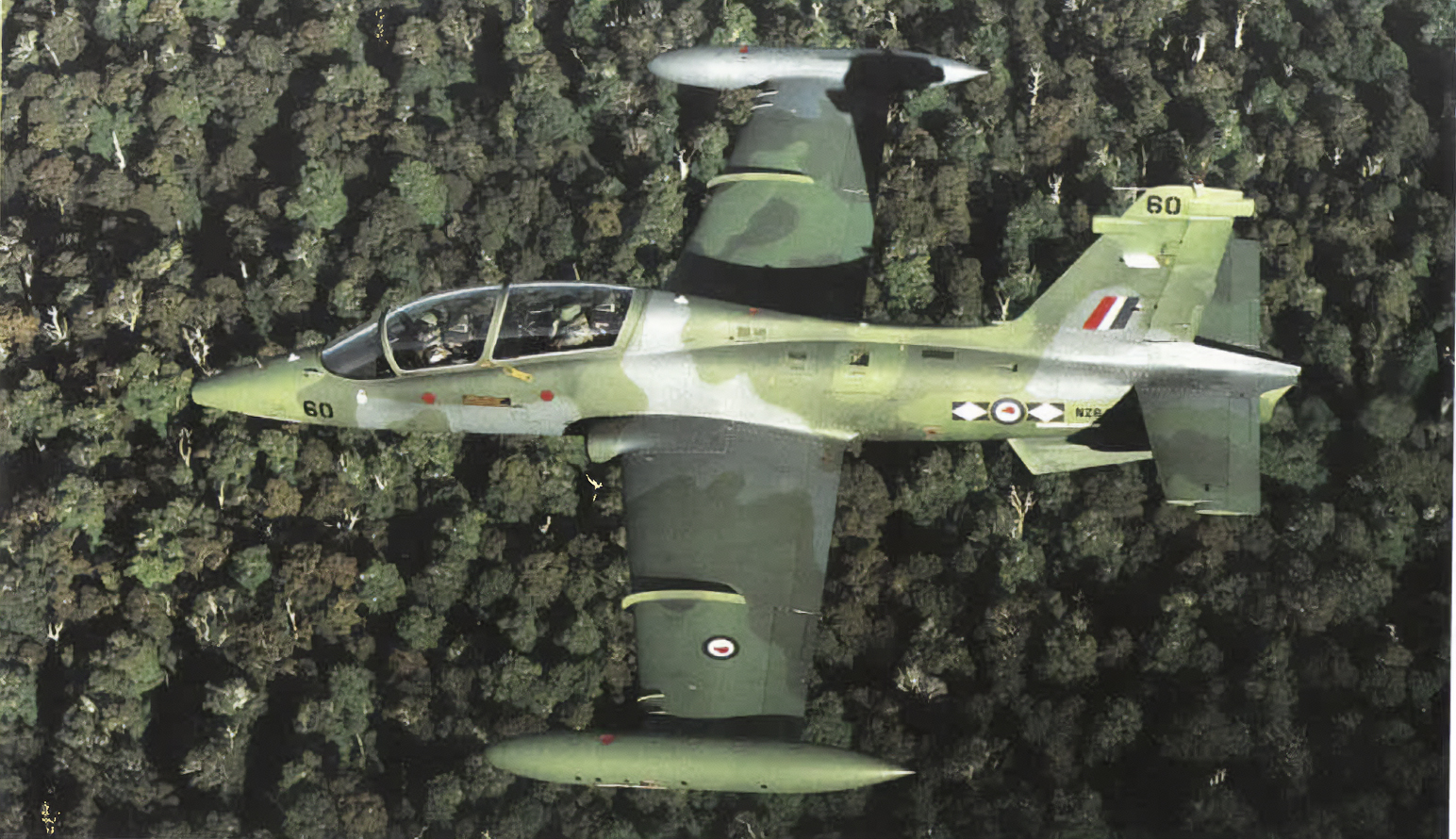
Trouble began very early in the career of the new trainer. Wet runway operations resulted in a number of flameouts. After analysing video recordings the air force discovered that water thrown up from the nosewheel was being sucked into the engine intakes. Aermacchi was called in for advice and provided a new nosewheel chine, which cured the problem. The first hint of more serious trouble came in September 1991 when the first of four compressor stall incidents occurred during slam acceleration. These were not consistently repeatable on any particular engine, so until a full cure could be found restrictions were placed on the flight envelope. This had a serious service implication because the primary restriction, requiring the aircraft to maintain greater than 240 KIAS below 5000ft, prevented ab initio student pilots from completing solo training. The RNZAF’s MB-339CB differs from the MB-339PD on offer to the RAAF in its cockpit configuration. Acceleration stalls were eventually traced to the air fuel ratio control unit, which was in effect flooding the engine as it accelerated through an area with a narrow operating stall margin. The root cause was that it was not well matched to the needs of the Viper 680-43, which was a stretch of the original Viper design. Rolls-Royce advised raising the engine idling speed, and developed a modified fuel unit. Rolls-Royce traced compressor stalls during rapid engine deceleration to the pressure ratio switch, which was also modified.
Then in mid 1992 an engine was stripped after a pilot reported vibration, and the centre engine bearing was found to be close to collapse. Another engine stripped in early 1992 after only 300 hours service revealed what Rolls-Royce called ‘unexpectedly high’ corrosion within the casing and ‘minor build discrepancies including some fitting damage’. The discovery was surprising as the engines had been delivered with a specified 1000 hour time between overhaul (the same engine is offered to the RAAF for the MB-339FD with a 1200hr TBO). Modifications were devised by Rolls-Royce and applied to the aircraft incrementally over the next two years during scheduled maintenance periods at RNZAF Base Woodbourne.
A Macchi was lost in October 1993, when NZ6465 crashed into a Northland swamp following engine failure. The two aircrew ejected safely. Coming in the wake of the type’s engine problems, this could have spelled a serious blow to the Macchi programme, but when the wreck was retrieved and examined it was found that the failure had been caused by foreign object ingestion, though it was unclear precisely when this had occurred. The airframe has since been stripped of usable components and dismantled — the fuselage is sitting outside the RNZAF Museum at RNZAF Base Ohakea, while the wings are currently in Australia. Another Macchi, NZ6460, suffered moderate damage in a night crash at RNZAF Base Ohakea, and at the time of writing was in Italy for rebuild in the factory jigs.
Possible future problems were also identified by the RNZAF when the location of crucial wiring looms came in for scrutiny. These had been laid across flexing parts of the airframe and were considered by RNZAF engineers to be a long term maintenance headache. As the aircraft aged, the RNZAF concluded, the insulation would become worn and short circuits would occur. It was an assembly issue that could have been picked up at that time had resources been available. Once the fault had been identified, negotiations followed with Aermacchi and a preventative fix was developed under warranty.
The 1995 blade cracking troubles simply added to the catalogue of what the media had begun to portray as a litany of failures. By then the Macchi was publicly seen in New Zealand as a bad buy — there was even a derogatory cartoon portraying a row of lemons with Macchi wings and RNZAF markings. This was unfortunate. The fact that many of the well publicised groundings were purely precautionary was not widely reported and nor were the difficulties really put in perspective. In fact, the headaches the RNZAF have had with the aircraft seem no worse than could be expected for any new product of such complexity. There has been little direct impact on the New Zealand taxpayer because the aircraft have been largely repaired under warranty.
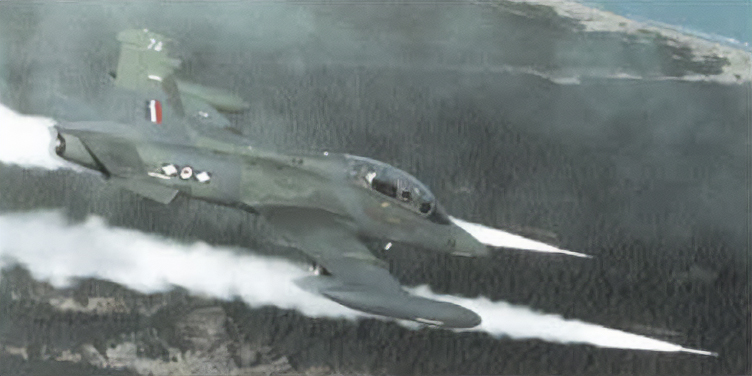
The RNZAF remains the only export customer of the MB-339CB model. The MB-339C was offered with modifications as a contender for the lucrative US joint services advanced trainer contest (JPATS), but after an extremely long drawn out selection process that contest was finally won by a modified PC-9. Current Macchi models on offer include the all digital MB-339FD for the RAAF and the glass cockpit MB-339CD being developed for the Italian Air Force. A prototype single seat attack variant, the MB-339K Veltro II, was also flown but has so far not been produced.
Whether the RNZAF’s difficulties will affect the chances of the Australian LIF contender remains to be seen. While the Viper has proven somewhat troublesome, any Australian engines would presumably incorporate the experience gained from trail breaking New Zealand service and would not be expected to encounter the same problems. At the end of the day, the real test of the aircraft is whether it has fulfilled the job it was bought for. The RNZAF is under no illusions; as far as it is concerned the Macchi has been a great success. Wing Commander Jan Wood said that “despite the problems we have faced so far with the … Macchi, the feedback from the operational squadrons on the quality of … graduates from the basic pilot course since the Macchi’s introduction has been very favourable. Representatives from each of the various roles within the Air Force — Transport, Helicopter and Attack, recently indicated that the new pilots reaching them had received, through the capabilities of the Macchi, training and experience similar to what is required in the respective operational roles.’
Teething problems or not, it would be hard to find a better endorsement than that. Matthew Wright is a NZ defence writer and one of three New Zealand civilians to have flown in an RNZAF Macchi.
Want to see more stories from trusted news sources?
Make Australian Aviation a preferred news source on Google.
Click here to add Australian Aviation as a preferred news source.




