
 iscover

A Jindivik landing on its skid undercarriage. (ASTA)
Aircraft of the ADF – N11 GAF Jindivik
 0 comment


N11 – Gaf Jindivik
Both of the RAN N10 and N11 allocations were for pilotless target aircraft. N10 was allotted to Northrop KD2R-5 Shelduck radio-controlled target planes, which were initially procured in 1963 as targets for gunnery practice for ships at sea. These small targets, with a wingspan of only 4m and a maximum weight of 148kg, had a maximum speed of 222mph (355km/h), and could be operated up to 23,000ft. They were powered by a McCulloch O-100-1 four-cylinder two-stroke air-cooled engine. The Shelduck could either be flown from ashore or launched from ships. Having an endurance of one hour, the drone was recovered by parachute if damaged by gunfire or on completion of the exercise.
The initial batches of aircraft were for 10 drones (which retained manufacturer’s serials between 7119 and 7723), for 20 (serialled N10-1 to N10-20), and then a further 10 (N10-101 to N10-110). As targets were lost, more were ordered and the type remained in service until 1974, with RAN procurement totalling 53 targets. The Shelduck had proved successful as a cost-effective gunnery target, and over 400 were eventually acquired by the British services.
This content is available exclusively to Australian Aviation members.
A monthly membership is only $5.99 or save with our annual plans.
- Australian Aviation quarterly print & digital magazines
- Access to In Focus reports every month on our website
- Unlimited access to all Australian Aviation digital content
- Access to the Australian Aviation app
- Australian Aviation quarterly print & digital magazines
- Access to In Focus reports every month on our website
- Access to our Behind the Lens photo galleries and other exclusive content
- Daily news updates via our email bulletin
The other target aircraft procured by the RAN was the Australian Jindivik. This had originally been designed as an inexpensive flying target, with a basic requirement for a speed of 435kt (805km/h), to operate up to an altitude of 40,000ft, and with an endurance of 75 minutes.
The Government Aircraft Factory (GAF) commenced design of Project B, which was to become Jindivik (Aboriginal for ‘the hunted one’), in response to a British specification for a high-speed pilotless target aircraft. A manned variant to test the Jindivik’s flying characteristics, Project C, known as the Pika, commenced taxi trials on October 29 1950.
The first Jindivik, initially serialled B-1 but subsequently changed to A92-1, was delivered to Woomera on October 19 1951, and the first flight of the type was made by A92-5 on August 28 1952. Twelve Mark 1 aircraft were produced (A92-1 to A92-12), powered by the 1050lb (4.7kN) thrust Armstrong Siddeley Adder ASA-1 turbojet engine. This initial batch of Mark 1 aircraft were delivered by May 1953.
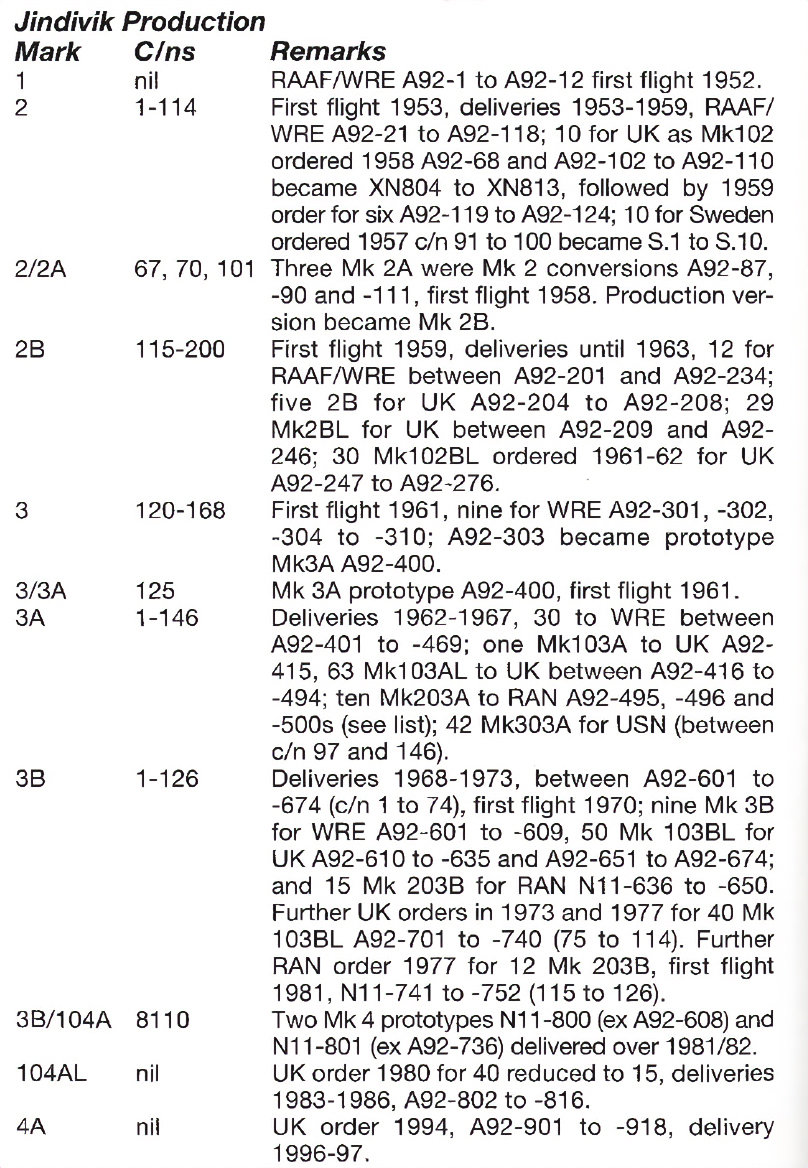
Fifty of the Jindivik Mark 2 variant, powered by the 1640lb (7.3kN) thrust Armstrong Siddeley Viper ASV-3 turbojet and identified by a larger air intake, were ordered in April 1953. These aircraft were for joint operation by the RAAF and the Weapons Research Establishment (WRE) at Woomera. Eventually this WRE order was increased to 88, and with an additional 16 for export to the Ministry of Defence in Britain (A92-21 to A92-124), Mark 2 deliveries continued from 1953 until 1959.

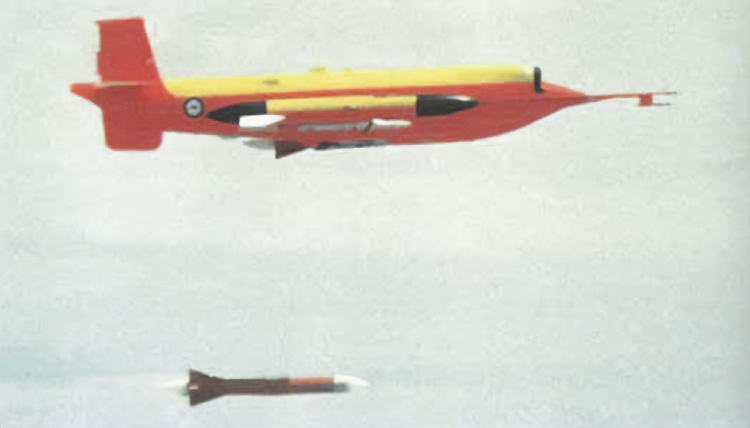
In Britain the aircraft were known as the Jindivik 102, and were modified by Fairey’s Weapons Division at Heston, Middlesex, over 1958-59. The first was then delivered to Llanbedr airfield in Wales, for Royal Aeronautical Establishment (RAE) operation, in January 1960. Flight trials were conducted from April until August 1960, when the aircraft was declared operational.
The Mark 2 was to meet the requirement for a realistic target that represented potential enemy aircraft, and improvements in design and weight saving led to an increase in speed from Mach 0.73 to 0.85, and an altitude improvement from 35,000ft (10,668m) to 48,000ft (14,630m). The Mark 2 first flew on December 11 1953, and the design showed its potential, when in 1955 the US expressed its interest in acquiring Jindiviks. In 1957, Sweden ordered 10 aircraft, taking Mark 2 production to 114 aircraft. As production had progressed, and operators became more experienced, the Jindivik system became more reliable and the malfunction rate fell from one in six sorties to one in 13.
In November 1958, the UK ordered a further 34 Jindiviks of an upgraded Mark 2 variant. This version incorporated bolt-on wing extensions, which increased wing area by 35% and the service ceiling to 52,000ft (15,850m). Three Mark 2 Jindiviks (A92-87, -90, -111) had been converted to the Mark 2A development standard in 1958, with the first flying on September 18 of that year.
The first of the improved production model, known as the Mark 2B and powered by the more powerful 1750lb (7.8kN) thrust Viper ASV-8 turbojet, flew on October 8 1959. Twelve were delivered to the RAAF (serialled between A92-201 and -234), and five (A92-204 to -208) to RAE at Llanbedr. These were followed by 29 Mark 2BLs (between A92-209 and A92-246), which were identical to the 2B but without engines and major equipment. A further 30 Mark 102BLs were ordered over 1961-62 (A92-247 to -276). In practice, in the UK all 64 of this model were referred to as the Jindivik 102B.
The Jindivik Mark 3, a Mark 2B airframe with a 2500lb (11.2kN) thrust Viper ASV-11 turbojet, arose from a requirement for a target to operate in excess of 60,000ft (18,300m), with 1m and 2m (40in and 80in) wingtip extensions. The first of nine Mark 3s built for the RAAF at Woomera (serialled A92-301 to -310, less -303 which was to become the Mark 3A prototype A92-400) were delivered from late 1960. The first flight was on May 12 1961, and this model was flown to assist development of the next definitive variant, the Mark 3A.
Navy Jindivik N11-752 with HUTTS towed target. This Jindivik crashed on takeoff from Jervis Bay in May 1992. (Defence PR) 34 Australian Aviation May 1996. A Jindivik landing on its skid undercarriage. (Asta)
The prototype Jindivik 3A, A92-400, first flew on November 10 1961. Mark 3A production was then to total a further 146 aircraft, delivered between 1962 and 1967. Thirty were for WRE (serialled between A92-401 and A92-469) for use at Woomera, 10 to the RAN (as the Mark 203A), 42 to the US (as the 303A), and 64 to UK (Mark 103A).
The US order for the Jindivik was interesting. On June 14 1962, three Jindiviks and associated control equipment were flown from Woomera to Point Mugu, California, for demonstration flights for the US Navy. In January 1964, the USN ordered 14 Jindivik Mark 303As, and 12 months later this order stood at 20. Ultimately, the American order was increased to 42. US Navy Jindiviks were operated from San Nicolas Island, 120km south-west of Los Angeles. The USN flew 175 Jindivik sorties, with more than half of the airframes being destroyed by missile strikes. US Jindivik operations ceased in 1968.
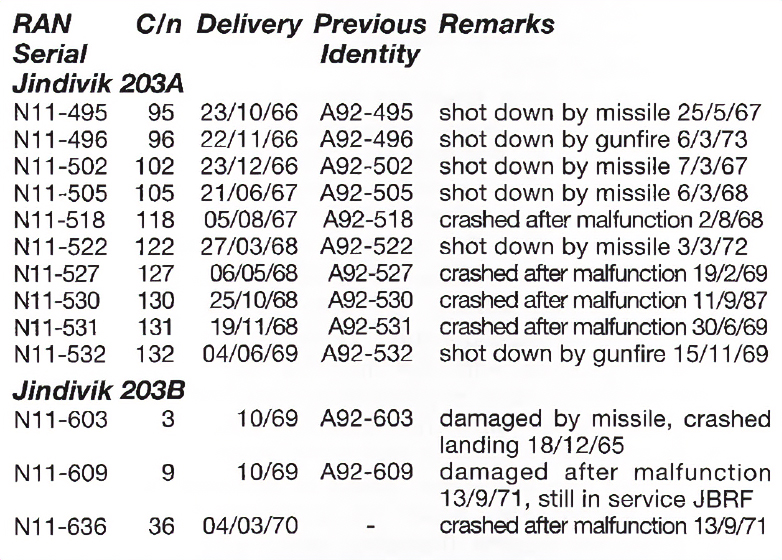
By May 1965, total Jindivik orders totalled 308, and over the next three years a further 100 were ordered. It was over this period that the RAN had identified a requirement for a target of the Jindivik’s capability, and in late 1966 accepted its first two Mark 3A aircraft (WRE machines A92-495 and A92-496). The RAN designation for the Mark 3A was the 203A. Over the following two and a half years the RAN took delivery of a further eight Jindiviks. These RAN 203A aircraft were serialled between A92-502 and A92-532 (later changed to N11-502 to N11-532).
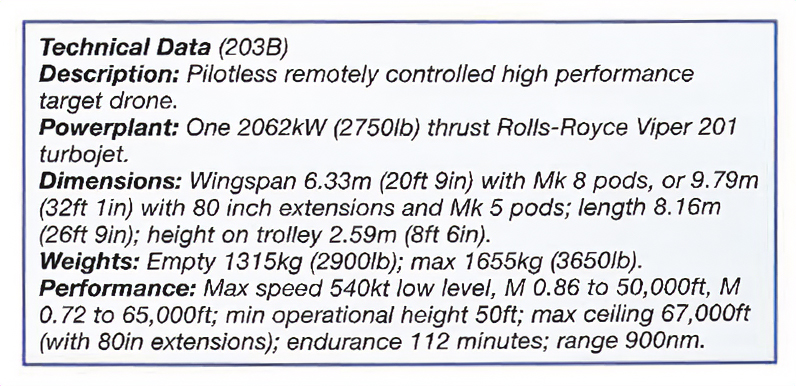
The next production block was the Jindivik Mark 3B. Although externally similar to 3A, the 3B introduced improved aerodynamics for high-speed manoeuvrability at low level, by use of more powerful control surface servomotors. Powered by the 2750lb (12kN) thrust Viper 201, the Jindivik 3B first flew on January 22 1970.
A total of 126 Mark 3Bs were built, of which 90 were produced for the UK. The initial nine were for WRE at Woomera, serialled A92-601 to A92-609. The first 50 British 103B variants were serialled A92-610 to A92-635 and A92-651 to A92-674.
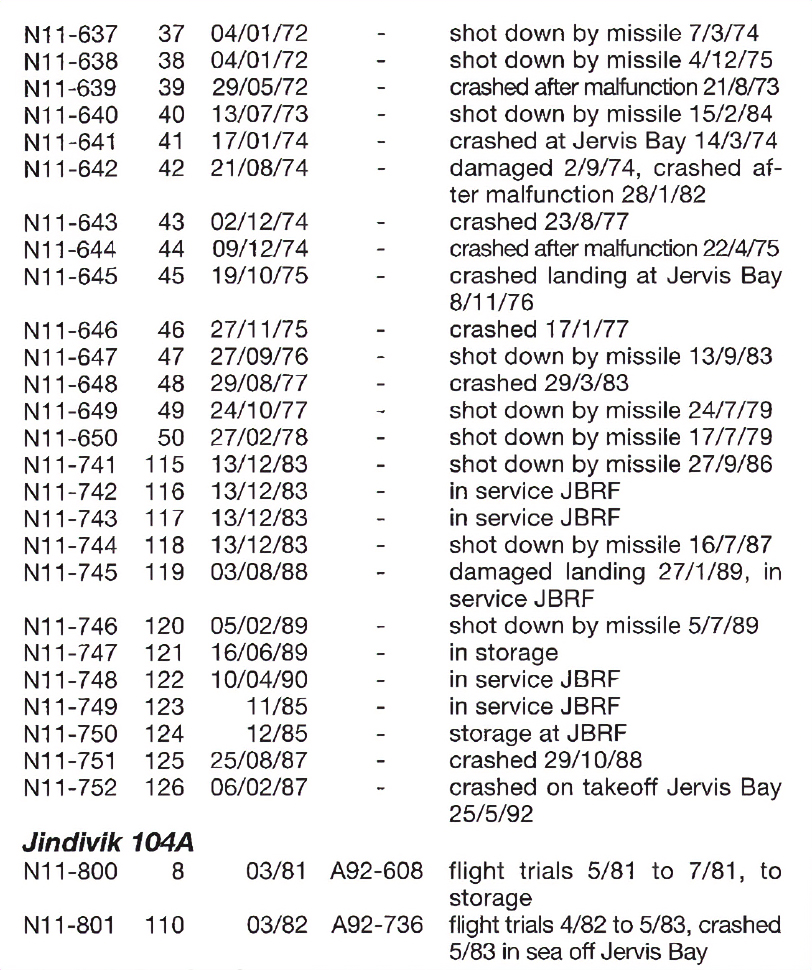
The RAN designation for the Mark 3B variant was the 203B. Two machines were initially supplied, A92-603 and A92-609 (later reserialled N11-603 and N11-609), followed by a production batch of 15 aircraft (N11-636 to N11-650). The first, N11-636, was accepted by the RAN on March 4 1970.
On August 23 1973, the UK announced an order for a further 32 Mark 103Bs, which was followed on April 7 1977 by orders being placed for a further 20 Jindivik 3Bs: eight for the UK and 12 for the RAN. These 40 British 103Bs were A92-701 to A92-740, and the 12 RAN 203Bs were serialled N11-741 to N11-752. These final Mark 3B orders took Jindivik production to 486 aircraft.
The 700 series aircraft differed from the earlier 600 series aircraft by incorporation of an improved autopilot. The first flight by N11-741 was on December 4 1981, and was accepted by the RAN on December 13 1983. Most of this production batch were stored until required for service in the late 1980s.
Operation at the RAN’s Jervis Bay Range Facility (JBRF), on the NSW coast 35km from Nowra, had commenced at the end of 1966, jointly operated with WRE (now DSTO) being the range contractor and the RAAF providing manpower support, but in 1975 the RAN assumed control of operations. Subsequently, a private contractor looked after maintenance and flight control on a three-yearly basis.
The Jindivik was progressively developed for target towing over the years for high and low altitude operation using liquid and solid fuel rockets for high-altitude flight. The aircraft were fitted with the “tonic” tow system (“Jin” and “tonic”) which provides a streamed decoy target for exercise missile firings.
By towing targets, the Jindivik can be recovered, which accounted for some high sortie numbers on several aircraft. At Woomera, A92-418 had achieved 285 flights over 10 years before being destroyed in October 1974. On August 15 1985, RAN Mark 203A N11-530, which had first flown in November 1968, completed its 200th flight from Jervis Bay. N11-530 eventually achieved 325 flights before crashing in 1987.
In January 1979, development of Jindivik Mark 4 was announced. The Mark 4/4A series used new stronger materials, allowing acceleration limits to be increased from +4.5g to +6g, and a revised electronic fit increased fuel payload to allow for a 112min endurance. Powered by a Viper 201, the Jindivik 4A was capable of a 520kt (965km/h) maximum speed.
The UK ordered 40 of the Mark 4As on April 9 1980, for delivery over 1983-86. This took total Jindivik orders to 526 machines, however, this latest order was subsequently reduced to 15.
In March 1981, the first of the improved Mark 4 prototypes, N11-800 (previously A92-608), was completed and delivered to JBRF for trialling. Flight testing started in May 1981, and this phase was completed after 16 flights that July. The second prototype, N11-801 (ex A92-736), flew an extensive trials programme of 47 flights over April-December 1982, before being lost off Jervis Bay with a flutter problem in May 1983.
The 15 production Mark 4A aircraft for the UK, designated Mark 104AL, were delivered from 1983 and were serialled A92-802 to A92-816. Included in this batch was the 500th Jindivik (A92-815), rolled out and handed over to the British MOD on September 12 1986.
In April 1994, the UK ordered 18 upgraded Mark 4A Jindiviks in a $35m contract. Production recommenced at Asta, as GAF had become, in early 1995 after a nine-year break in Jindivik manufacture. These aircraft are serialled A92-901 to A92-918, with the first due for completion this September. Production is planned to continue until August 1997. In the UK, the Jindivik continues to be operated from Llanbedr, over the Cardigan Bay air weapons range.
Asta also had ambitious plans to develop the Jindivik Mark 4B, powered by a Viper 202, and capable of carrying a range of towed targets featuring radar and infra-red augmentation to simulate real aircraft. The 4B was planned to fly at altitudes between 40ft (12m) and 65,000ft (19,800m), with a maximum speed of 540kt (1000km/h). With a range of some 2000km, this variant was also proposed to carry a range of electronic sensors in a surveillance role. Lack of firm orders saw the programme terminated. The RAN currently operates seven Jindiviks at JBRF. The drones and ground control systems are operated for the Navy on a commercial basis by British Aerospace Australia. The current contract was awarded in September 1994 and runs until 1997. Surviving Jindiviks on display include A92-22, an overall white Mark 2 Jindivik, now held by the RAN. This was the first Mk 2 aircraft to complete a flight, as A92-21 had flown first but broke up over Woomera at 15,000ft. Other Jindiviks which remain on display include Mark 1 A92-9 at RAAF Edinburgh SA, Mark 2 A92-47 at the RAAF Museum Point Cook, Mark 3A A92-511 at RAAF Wagga, and Mark 3B WRE-601, being restored at the Moorabbin Air Museum. One of the British Jindiviks, Mark 103B A92-664, is displayed at an aviation museum near Llanbedr. The RAN is currently evaluating new unmanned aerial targets for a requirement under Joint Project 7 (JP7). The performance characteristics for the new target are for operation from sea-skimming heights up to 50,000ft, an endurance in excess of an hour, an effective radio control range of 50nm (983km), with a sustained speed of at least Mach 0.85 in level flight at 10,000ft.
Asta is one of the six teams bidding for JP7, and is teamed with Tracor, to offer the MQM-107E target. If successful, Asta would maintain and operate the drone. Another contender is Raytheon with its MQM-107D, teamed with British Aerospace Australia. Tenders closed on January 31 this year, and the RAN is expected to award the $200 million contract in August (refer Defence Update for further details). In Australia, the Jindivik is planned for withdrawal from service at the end of 1997. The new targets will not only be operated at JBRF on the east coast, but will also be flown in the West Australian Exercise Area near HMAS Stirling at Perth.
Want to see more stories from trusted news sources?
Make Australian Aviation a preferred news source on Google.
Click here to add Australian Aviation as a preferred news source.




