
 iscover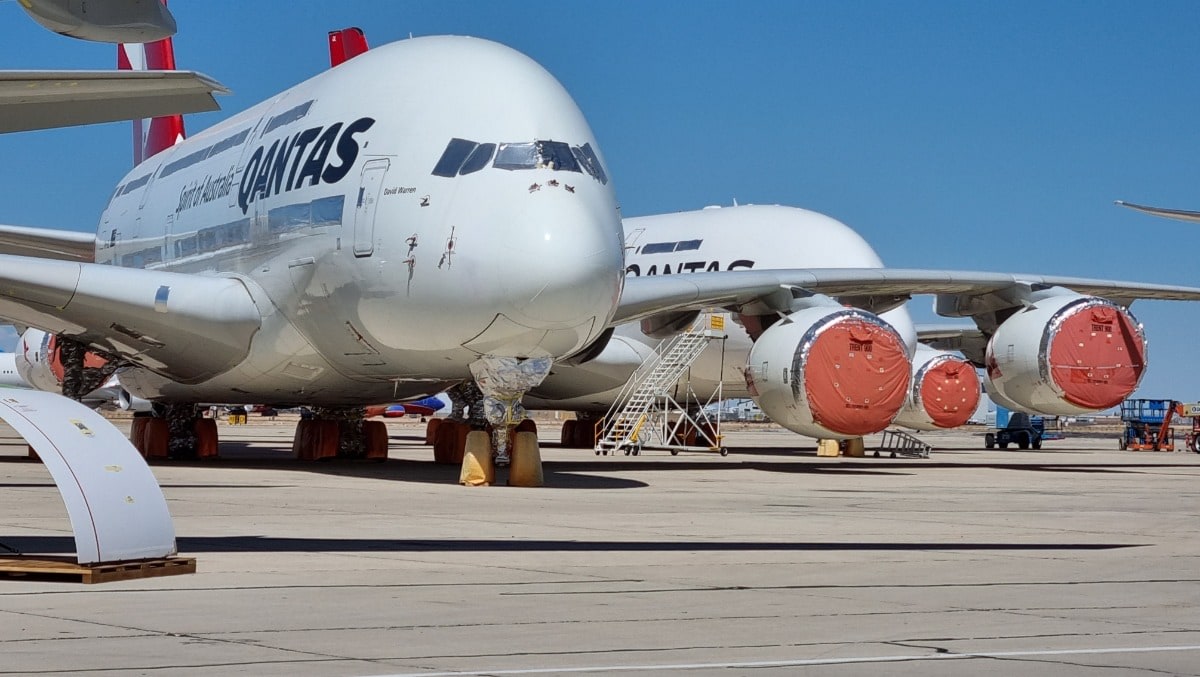
The second and final Qantas A380 has been dismantled in the Victorville desert boneyard.
A photo taken by aviation photographer Andrew Hunt shows previously scrapped VH-OQF alongside another Super Jumbo once owned by the Flying Kangaroo, certainly VH-OQE.
This content is available exclusively to Australian Aviation members.
A monthly membership is only $5.99 or save with our annual plans.
- Australian Aviation quarterly print & digital magazines
- Access to In Focus reports every month on our website
- Unlimited access to all Australian Aviation digital content
- Access to the Australian Aviation app
- Australian Aviation quarterly print & digital magazines
- Access to In Focus reports every month on our website
- Access to our Behind the Lens photo galleries and other exclusive content
- Daily news updates via our email bulletin
- Unlimited access to all Australian Aviation digital content
- Access to the Australian Aviation app
- Australian Aviation quarterly print & digital magazines
- Access to In Focus reports every month on our website
- Access to our Behind the Lens photo galleries and other exclusive content
- Daily news updates via our email bulletin
While its registration cannot be verified, all other Qantas A380s have now left California and are either in service or being upgraded in Abu Dhabi.
Qantas grounded its entire fleet of 12 A380s during the pandemic, with most sent to the notorious Southern California Logistics Airport, better known as Victorville.
The business has been slowly returning them to commercial flying.
As of 13 April, Qantas now has seven A380s back flying commercially: VH-OQB, VH-OQD, VH-OQH, VH-OQK, VH-OQJ, VH-OQG, and VH-OQL.
Of the rest, VH-OQC, VH-OQA and VH-OQI are currently in Abu Dhabi receiving a cabin upgrade.
Australian Aviation reported earlier this month how Qantas welcomed back into service VH-OQL, which is now flying between Sydney and Hong Kong.

It comes after another A380 from the national carrier made national news in December when it made an emergency landing in Baku while en route to London.
The incident happened after a sensor light alerted pilots to the possibility of smoke in the cargo hold days before Christmas.
The aircraft turned around above Tbilisi, Georgia, before touching down in Azerbaijan.
Investigations later revealed no evidence of smoke, meaning the incident was due to a fault with the sensor and a false alarm.
Qantas dispatched a recovery flight, which landed in the British capital on Christmas Day.
The grounded aircraft, VH-OQH, was later deemed safe to fly and returned to commercial service days later.
VH-OQA, Qantas’ first A380, was involved in arguably Australian aviation’s most serious-ever safety incident, when its Rolls-Royce Trent 900 engine exploded shortly after it took off, causing a major fire in November 2010. It subsequently returned to service.
A380s from other airlines have also made the news.
Emirates relaunched its daily service from Sydney to Christchurch using its A380s — the only flight across the ditch to use the super jumbo.
The airline also restarted its daily Melbourne–Singapore–Dubai service as EK404/405 using its Boeing 777-300ERs.
“Our Melbourne–Singapore–Dubai service will offer travellers a strong connection opportunity between two global travel hubs, providing access to substantial leisure and business activities, plus fantastic onwards links to and through Dubai,” said Barry Brown, divisional vice-president Australasia at Emirates.
“We also welcome back our Sydney–Christchurch service, a favourite for travellers between New Zealand and Australia. As the only A380 experience between the sister countries across the Trans-Tasman, passengers will be able to take advantage of Emirates’ signature experience, including a superior first and business class offering, plus our highly popular premium economy cabin, one of the best in the air.”
Want to see more stories from trusted news sources?
Make Australian Aviation a preferred news source on Google.
Click here to add Australian Aviation as a preferred news source.







[email protected]
says:I do find it hard to believe that QF is destroying perfectly good aircraft when they are in dire straights for not having upgraded their long haul fleet a long time ago. For almost two decades starting in the nineties almost all major airlines were re-equipping/upgrading to twin engine long haul B777 equipment but sadly QF persisted with just the then ageing but great B747-400 and publicly advising all that the seat mile costs of the B777 were more than their B747. Today, maybe 30 years later, QF has missed out on a generation of what is accepted was the most efficient, profitable, versatile and popular aircraft in the world. Today, whilst our competitors have taken delivery and operating what is now accepted as the worlds best available aircraft, the A350 series, QF is still struggling and emerging from A330-200 utilisation on routes that they were never intended for, still has not a full fleet of B787’s and here we are scrapping very young airframes which could serve us well for many years, it does not compute. Meantime whilst we await the birth of our A350-1000, 2 years away? our good friends and neighbours in Fiji will take delivery of their A350’s in about 2 months!!! Further, the QF advised A350-1000 may not be as good as we expect, with only about 237 seating that is about 100 less than a normal production model which either means that the unit cannot operated the ultra long haul routes as planned thus by seating configs that is a cute way of regulating downwards the ZFW to achieve the result or, the cabin configuration cannot support more than 237 pax for the planned extended journey. I really believe some explanations are due as it is not a good look.