
 iscover

Victor Pody shot this Qantas 787, VH-ZNJ, in special Qantas 100 livery.
Profiled: The next generation of aircraft arriving in Australia
 0 comment


In December, Qantas began its Project Winton fleet renewal program by welcoming its first Airbus A220. It marks the start of a new era of aircraft design that uses advances in engine technology and fuselage materials to travel further while burning less fuel in smaller planes. Here, we profile the new recruits.
Boeing 787 Dreamliner
Despite the controversy with the narrow-body MAX, the wide-body 787 has been a quiet success for the American planemaker since its first delivery to Japan’s All Nippon Airways in 2011. As airlines pivoted away from double-decker aircraft such as the A380 and 747, the Dreamliner filled the gap by being both a workhorse suited to middle-range routes as well as being able to fly ultra-long-haul. Already, it’s the aircraft chosen by Qantas to fly directly from Perth to London and Auckland to New York – two of the longest services in the world.
Arguably, it was the 787 that initiated the next-generation revolution. The aircraft was the first commercial airliner mostly made of carbon composites or super durable plastics. This mini-revolution in manufacturing meant the Dreamliner could be more fuel-efficient and fly far further than similarly sized aircraft. The 787 also has a uniquely space-age feel inside the cabin – gone are conventional window shades, for example, in favour of a button that gradually dims the light. It even sounds different, with an electric whirr replacing the traditional hydraulic hiss.
This content is available exclusively to Australian Aviation members.
A monthly membership is only $5.99 or save with our annual plans.
- Australian Aviation quarterly print & digital magazines
- Access to In Focus reports every month on our website
- Unlimited access to all Australian Aviation digital content
- Access to the Australian Aviation app
- Australian Aviation quarterly print & digital magazines
- Access to In Focus reports every month on our website
- Access to our Behind the Lens photo galleries and other exclusive content
- Daily news updates via our email bulletin
It hasn’t been without its problems, though. In 2013, 50 of the world’s 787s were grounded for more than three months after an incident involving its lithium-ion batteries, one of which caused an electrical fire. More serious has been supply chain issues with its development that predated even the problems encountered during COVID-19. Qantas, for example, saw its final delivery of three delayed for years, with the last arriving in 2023.
Nonetheless, it’s a testament to its game-changing design that Qantas surprisingly ordered a further 12 last year to replace its creaking A330s. The order (comprised of four -9s and eight -10s) effectively stopped the Flying Kangaroo from being an entirely Airbus-operated airline and meant it would eventually have 26 Dreamliners in its final fleet.
737 MAX

The 737 MAX family has become arguably the most controversial commercial airliner of all time after two fatal crashes in Ethiopia and Indonesia killed 346 people. It resulted in the US Department of Justice fining Boeing US$2.5 billion, accusing the planemaker of “fraudulent and deceptive” conduct and attempting to “cover up their deception”. Effectively, authorities ruled a rotten culture at the planemaker meant profit was put ahead of safety as staff hoodwinked safety officials into signing off the aircraft. Fast-forward two years, and the FAA was forced to ground the 9 variant after a door plug – gobsmackingly – fell off in mid-air. (More of that later.)
Put those rather significant safety concerns to one side, though, and the MAX is a revolutionary aircraft that is more than a match for its rival Airbus products. Bonza has a fleet of six MAX 8s, while Virgin has three. The latter, though, is to take delivery of 14 MAX 8s in total, alongside 25 MAX 10s. While the Boeing has a smaller range and capacity than the A321neos, it features superior fuel efficiency and better cargo capacity.
Those advantages have allowed Bonza to upend the Australian market, flying point-to-point routes that skip out capital cities. This low-frequency, low-cost and high-capacity model would have been uneconomical for a start-up airline using the old 737-800 aircraft generation. “We have the most fuel-efficient and youngest fleet in Australian skies,” CEO Tim Jordan told Australian Aviation last year. “So there are benefits for us coming to the market with brand new aircraft.”
Airbus A220-300

Qantas is set to take delivery of at least 29 A220-300s to fly routes previously served by its 717s but has the option to buy many more. The Flying Kangaroo has already received two of the 137-seat aircraft, with another five expected by mid-2025. Unlike its predecessor, the next-generation model can fly non-stop between any two points in Australia, opening up new domestic and international short-haul routes. It will mostly connect smaller capital cities like Canberra and Hobart with larger ones like Brisbane, Melbourne and Sydney.
The aircraft has an unusual history. The wider A220 type was initially designed by Bombardier as its CSeries and launched at the UK’s Farnborough Air Show back in 2008. However, a stoush with Boeing over claims it was being sold on the cheap led to Airbus partnering with the Canadian plane maker and rebranding it as the A220. More than 300 have been delivered to airlines, including Air Canada, Air France and Delta. Qantas’ first touched down in December last year and boasts perhaps the most intricate and complicated livery in the airline’s history. VH-X4A’s paintwork features the artwork of Pitjantjatjara artist Maringka Baker and comprises more than 20,000 dots.
Airbus A321 LR / XLR
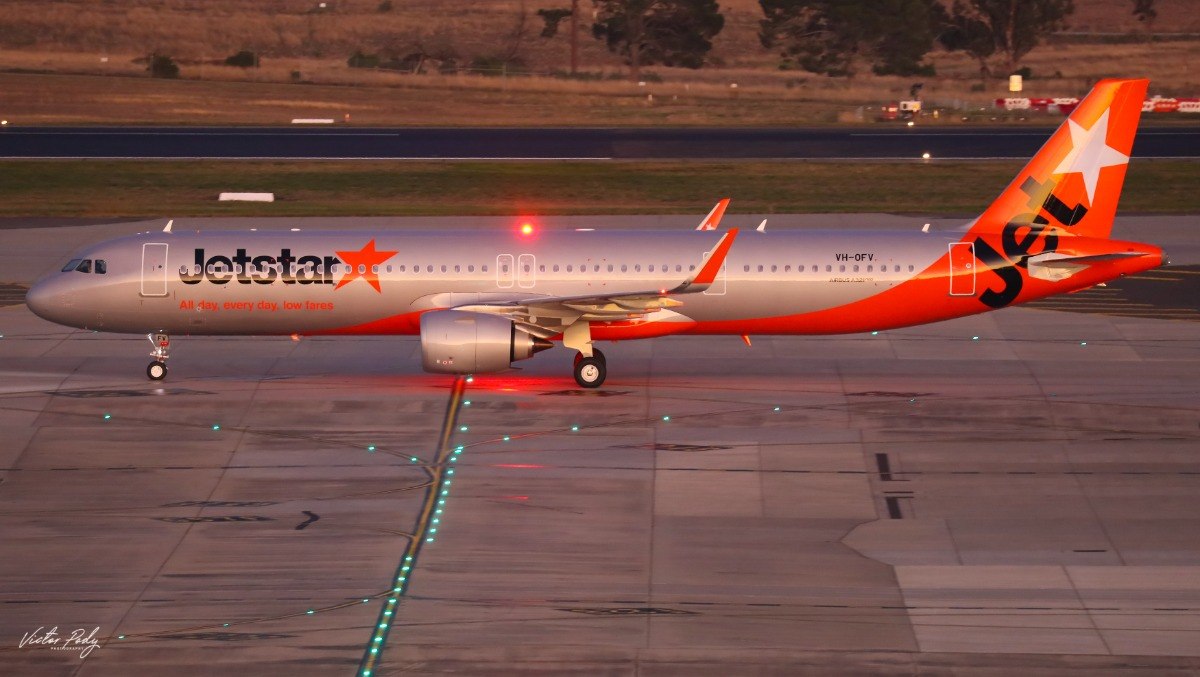
The A321 is set to dominate Australia’s skies as the Qantas Group’s domestic aircraft of choice, replacing the 737-800 and beating off competition from the beleaguered Boeing 737 MAX. Two variants are on the way, the LR (long range) and XLR (extra long range), with orders from both Jetstar and its big brother airline. The A321 family began as a stretched version of the A320 but has evolved to join Airbus’s ‘Neo’ range of fuel-efficient aircraft.
Jetstar’s first, VH-OFE, arrived in July 2022. The airline’s then CEO, Gareth Evans, said its design means it features wider seats for customers, larger overhead lockers, in-seat USB charging, and in-flight digital streaming technology. “An Australian first for a low-fares airline,” Evans said. “The A321LR burns significantly less fuel than previous generation aircraft, and advanced weather detection technology will enable our pilots to plot smoother and more fuel-efficient flight paths. That translates to a saving of 1.2 million kilograms of fuel annually — a reduction of almost 4,000 tonnes of emissions or the equivalent of removing 1,500 cars from the road each year.” The ‘LR’ variant utilises extra fuel in three ‘Additional Centre Tanks’ to fly routes of up to 4,000 nm with 206 passengers, opening up new routes for the budget airline. In 2024, it’s flying to Seoul, Auckland, Rarotonga, Narita (Tokyo), Fiji, Seoul and Osaka. Jetstar has 18 A321 LRs on order and 20 A321 XLRs, while parent Qantas brand has committed to 20 XLRs.
Airbus A350-1000

In August last year, Qantas confirmed it would order 12 Airbus A350s to help replace its ageing A330 fleet. The purchase of the traditional A350-1000 was in addition to the specially adapted version of the type set to launch Project Sunrise. It means that, alongside the order for the aforementioned narrow-bodies, the Flying Kangaroo will transition to become a predominantly Airbus carrier over the next few decades. In his final flourish as boss, former CEO Alan Joyce argued the order amounted to a “generational decision” for the company.
“They’ll unlock new routes and better travel experiences for customers and new jobs and promotions for our people,” Joyce said.
Qantas’s A350-1000s, at 72.25 metres, will be 8.5 metres longer than the A330s they’ll replace and the same length as the double-decker A380. Powered by Rolls Royce Trent XWB-97 engines, they’ll burn 25 per cent less fuel and be significantly quieter. The aircraft has been a game changer for the European planemaker as international airlines began to look beyond the 747 and A380 for long-haul routes. A Swiss Army Knife of the skies, the A350 can shift from short to ultra-long-range operations up to 16,000km. It means it’s at home servicing traditional routes as it is growing emerging markets, such as Shanghai to Boston or Paris to Santiago. It’s also primed for the lucrative world of next-generation business and first-class travel, with 40 per cent more area for premium-category seating. Airbus boasts the A350-1000 has the “quietest twin-aisle cabin in the skies”, wider seats and “elegant LED ambient lighting” that can minimise the effects of jet lag.
Airbus A350-1000 ULR

Quite possibly the most anticipated aircraft in Qantas history, the A350-1000 ULR is the specially adapted plane chosen to launch Project Sunrise. It means, for the first time, regular commercial services will operate direct from New York and London to Sydney and Melbourne. It promises to be a watershed moment not just for the local industry but for Australia as a country, too.
“It’s the last frontier and the final fix for the tyranny of distance,” said Joyce, announcing the aircraft’s purchase in May 2022.
The Flying Kangaroo will likely be the only international carrier to acquire the now-named ULR variant, which will be built with additional fuel tanks necessary to make the 20-hour flight possible. Delivery of the fleet of 12 will begin by the end of next year and be complete by the end of 2028. “It is a unique opportunity for Qantas because Australia’s so far away from everywhere,” said Joyce. “And we could justify a fleet size of a significant amount of aircraft that makes it economic. We have three major cities on the East Coast in Brisbane, Sydney and Melbourne. And having flights to London, Frankfurt, Paris, New York, Chicago, Rio de Janeiro and Cape Town, from those cities, creates a significant sub fleet and economics of scale that we think will work really well.”
Each A350-1000 will focus on premium seating, with the aircraft carrying just 239 passengers despite the potential to seat 480. That will comprise six enclosed first-class suites, 52 business suites, 40 premium economy seats and 140 standard economy seats, with a “wellness zone” offering a place for passengers to stretch their legs. Qantas says even its lower-tiered cabins would have the most generous seat pitches of any of its aircraft, and its teams had gone so far as to test the “breathability of the seat fabrics”. The real magic will be in its top-tier cabins. The luxurious first suite provides customers with a boutique hotel experience in the comfort of their cabin, with a wide fixed bed, separate recliner chair and a personal wardrobe. The smaller business class, meanwhile, features a cushioned leather ottoman and an 18” ultra-high-definition touchscreen TV.
Want to see more stories from trusted news sources?
Make Australian Aviation a preferred news source on Google.
Click here to add Australian Aviation as a preferred news source.




