
 iscover
In Focus
Written in the Sky
 0 comment


Written in the Sky is a panoramic autobiographical work that includes fascinating historical background of the times and well-explained technical details of the unusual variety of military and airline aircraft that Mark Carr has flown with two military services and two airlines. It was inspired by classic accounts of military and airline flying, particularly Feet Wet: Reflections of a Carrier Pilot by Paul Gillchrist, and Fate is the Hunter by Ernest K Gann. A Fortunate Life by A B Facey is also relevant to Carr’s relatively humble background and the trials and tribulations that lead to a successful and satisfying career’s end.
The work is aimed at any reader with an interest in aviation, civil or military, life at sea on an aircraft carrier, flight training, domestic flying in Australia, international airline operations or expatriate life in Hong Kong. Also, the demise of the Navy’s fixed-wing aircraft capability and the traumatic Australian Pilots’ Dispute have been under-represented in literature, and Carr attempts to set things right with historical background and personal experience to the descriptions of these events.
This content is available exclusively to Australian Aviation members.
A monthly membership is only $5.99 or save with our annual plans.
- Australian Aviation quarterly print & digital magazines
- Access to In Focus reports every month on our website
- Unlimited access to all Australian Aviation digital content
- Access to the Australian Aviation app
- Australian Aviation quarterly print & digital magazines
- Access to In Focus reports every month on our website
- Access to our Behind the Lens photo galleries and other exclusive content
- Daily news updates via our email bulletin
The book can be marketed not only to aviation and history enthusiasts but also to a broader audience, including older teenagers, as an inspirational book that demonstrates the value of persistence, dedication, hard work and the making use of opportunities that can sometimes arise, when all seems dark.
Written in the Sky comprises an introduction, author’s note, 20 chapters and an epilogue for 500 pages.

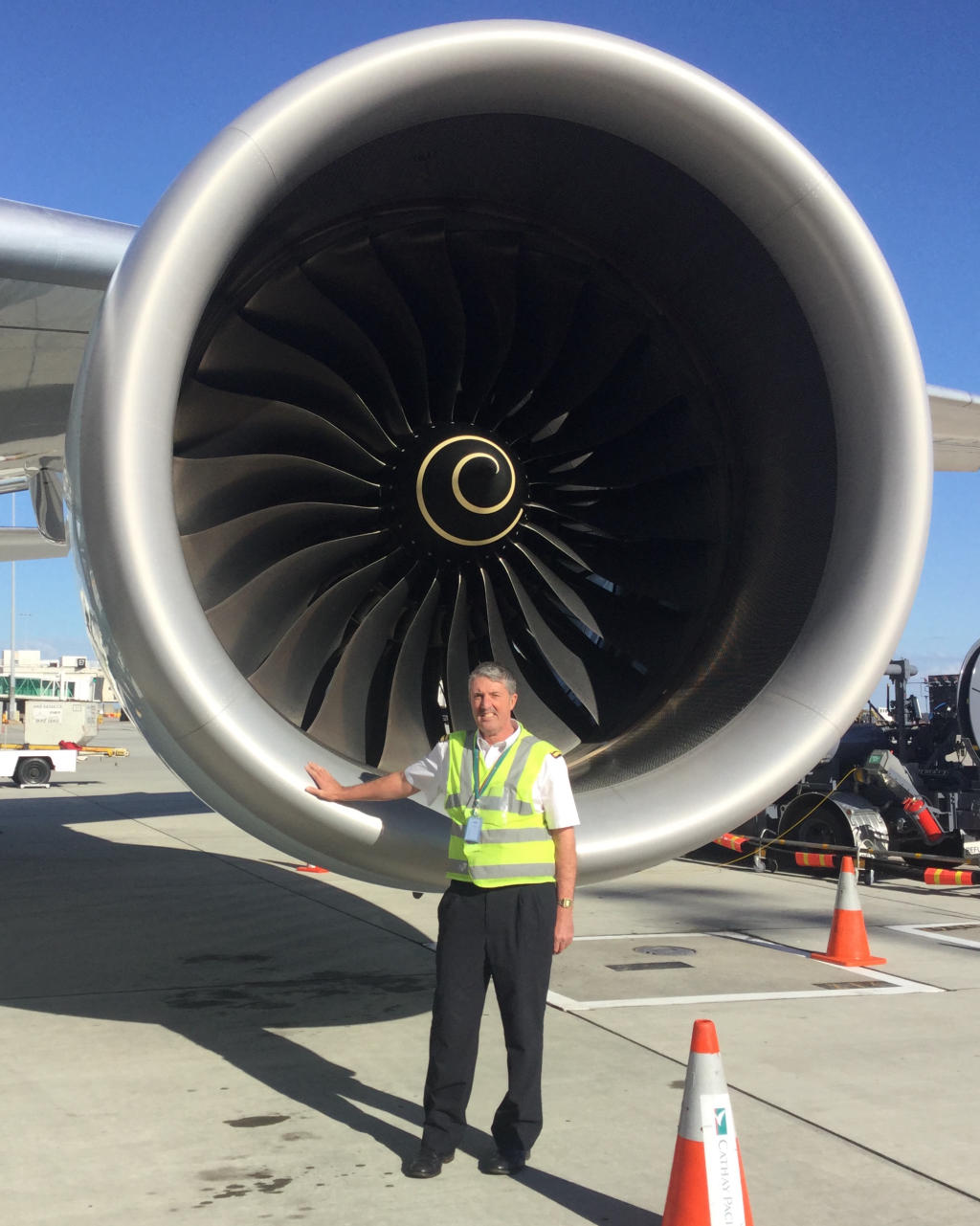
Captured by Andy Donaldson
Book extracts
I was sweating, despite the several kilometres high we were in the upper atmosphere. Two of us grunted under the g as I pulled the Macchi out from a plunge toward the blue sea. The g suit squeezed legs and stomach and I fought against it to clear my vision. Now the jet’s nose was arcing up and its speed began to wash off. I kept back pressure on the control column until I began to feel a ‘buzz’ through it, then the vibration and shuddering of the whole aircraft as the wings approached their stalling angle. We were locked in a simulated aerial combat.
The pilot tried to throw the Boeing onto Runway 13, but there was confusion in the cockpit as the aircraft, not slowing on the rain-slick runway, floated and kept floating. Belatedly, the captain had pulled back on the reverse thrust levers on the backs of the four throttles, and his feet pressed the tops of the big rudder pedals to apply maximum braking. Now, he had overridden the automatic brakes that he had set at too ‘soft’ a setting for the conditions. Too late. The far-end of the runway loomed. They would soon be over the rocky sea wall and into the choppy grey-green water as, despite their efforts, the Boeing would just not slow down enough. In a desperate attempt to avoid running off the far-end of Runway 13, the captain kicked the left rudder pedal and the jet yawed left into a grinding ‘ground loop’. It swerved off what remained of the runway and bucked and tore through the sodden grass. Then, with the momentum of well over two hundred tonnes of metal, fuel, cargo and humanity, it lurched over the rocks of the sea wall, the landing gear now ripped off and the airliner on its belly and finally slowing; but, still, the jet fell into Hong Kong harbour. It surfed along for a few metres, then came to rest floating alongside the rocks and ended up almost parallel to the runway, its nose incongruously pointing back in the direction from whence it had come.
Especially at low altitudes, a fire or sudden control problem could be catastrophic and, likewise, a manual bail out would not be an option. At high altitude windblast, cold and the sudden lack of oxygen could render a pilot unconscious before he got to pull any ripcord. The high-speed airflow could tear his opening parachute to shreds.
But then I heard the doctor interrupt, ‘Number Eight, put your mask on.’
No problem. With my oxygen mask on, the exercise was over.
‘So, Number Eight, what do you think? What were your hypoxia symptoms?’
‘I was gasping a little, but otherwise no problem, Sir. I counted OK and then put my mask on.’
‘It wasn’t you who put your mask on,’ the doctor said. ‘You lost consciousness and I did it for you’.
I was sweating, despite the several kilometres high we were in the upper atmosphere. Two of us grunted under the g as I pulled the Macchi out from a plunge toward the blue sea. The g suit squeezed legs and stomach and I fought against it to clear my vision. Now the jet’s nose was arcing up and its speed began to wash off. I kept back pressure on the control column until I began to feel a ‘buzz’ through it, then the vibration and shuddering of the whole aircraft as the wings approached their stalling angle. But now, contrary to my previous training, I deliberately maintained the buffet at the lower speeds as I had been taught by the Air Warfare Instructor. He was sitting through all this in the rear cockpit. Buffet meant that the Macchi’s wing was at its maximum lift-producing potential, which would enable the pilot to out-turn an opposing jet and bring his weapons to bear. The g had eased and I was gasping through my oxygen mask, over the top of the huge loop, and once again the speed and the g built up, the buffet disappearing with the building speed, because now I had to flick my eyes to the g meter on the panel to ensure that I did not overstress the aircraft near its g limit. I also had to crane my neck up and back to look through the canopy, which was an effort, because my head and helmet now felt four times their normal weight. There was another blue and white Macchi with two red and white helmets visible in the darkness of its cockpit, in plain view opposite, plummeting down while I was now zooming up again, and I had to keep it in sight.
Want to see more stories from trusted news sources?
Make Australian Aviation a preferred news source on Google.
Click here to add Australian Aviation as a preferred news source.




