
 iscover
A different beast
 0 comment


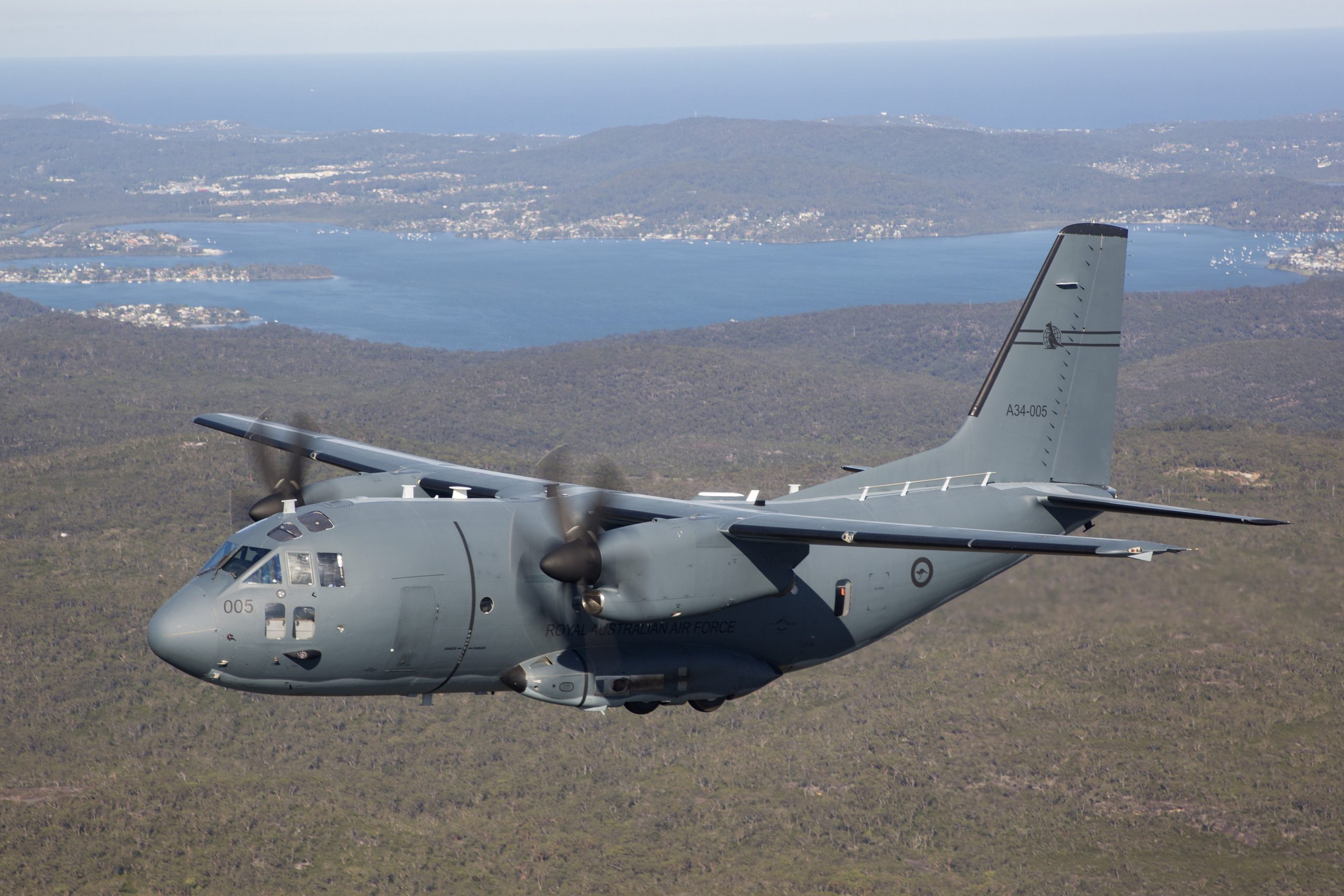
The C-27J is not a straight replacement for the RAAF’s much-loved Caribou, but nor is it a mini Hercules. With all 10 aircraft now in the fleet, Australian Aviation visited 35 Squadron at RAAF Base Richmond to learn more about the growing maturity of the ADF newest airlift asset.
What is a Spartan
The C-27J is a modern development of the 30-year-old G.222/C-27A which enjoyed a moderately successful but relatively short-lived career in Italian and US service respectively.
The C-27J was jointly-developed by Alenia and Lockheed Martin to replace older C-130s and to complement the larger C-130J Super Hercules in service. The C-27J was a considerable upgrade from the original G.222 and, with a view to commonality, shared many of the C-130J’s systems including engines, the cargo handling system, and avionics.
This content is available exclusively to Australian Aviation members.
A monthly membership is only $5.99 or save with our annual plans.
- Australian Aviation quarterly print & digital magazines
- Access to In Focus reports every month on our website
- Unlimited access to all Australian Aviation digital content
- Access to the Australian Aviation app
- Australian Aviation quarterly print & digital magazines
- Access to In Focus reports every month on our website
- Access to our Behind the Lens photo galleries and other exclusive content
- Daily news updates via our email bulletin
The USAF’s Light Cargo Aircraft program and the US Army’s Future Cargo Aircraft programs were merged to become the Joint Cargo Aircraft (JCA) program, but the industrial tie-up between Alenia and Lockheed Martin was dissolved in 2006 when Lockheed Martin focussed its efforts in marketing the C-130J for JCA in opposition to the smaller C-27J. Alenia subsequently joined forces with L-3, and in 2006 the C-27J was selected for the JCA requirement.
The JCA was designed to fulfil the roles of intra-theatre critical resupply, casualty evacuation, air drop of personnel and supplies, aerial sustainment, troop transport, and homeland security missions. L-3 was appointed as the US prime contractor for JCA, and was to modify standard ‘green’ C-27Js at its Waco, Texas facility for service. After an initial requirement for about 150 aircraft was published, 75 C-27Js were eventually approved.
But Lockheed Martin’s C-130J US marketing and lobbying efforts began to pay off, and the JCA program was abandoned in 2013 in favour of buying additional C-130Js for the ANG. Thus, the JCA order was capped at just 21 C-27Js, all of which were almost immediately retired and placed in storage at the US DoD’s Aerospace Maintenance and Regeneration Group (AMARG) ‘boneyard’ in Arizona.
In 2014 seven of the JCA C-27Js were regenerated and passed on to the United States Army Special Operations Command (USASOC) Flight Company (UFC) for high altitude jump and tactical vehicle load training at Fort Bragg.
The US Coast Guard took the remaining 14 C-27Js from 2015 and rebadged them as the HC-27J for the maritime patrol, drug and migrant interdiction, disaster response and search and rescue missions.
Compared to the standard C-27J as operated by Italy, Lithuania and several other nations in small numbers, the JCA specification adds ballistic armour protection around the cockpit and loadmaster station, an enhanced communications suite, an enhanced electronic warfare self-protection capability, and a cargo handling system similar to that of the C-130J.
Meanwhile, the RAAF’s Project AIR 8000 Phase 2 Battlefield Airlifter (BFA) had been an active project for more than 12 years. The previous Project AIR 5190 ran for more than a decade before that and reportedly resulted in the C295 being selected in 2000. Curiously, this selection was never formally announced, and it was subsequently reversed, although it is unlikely the C-27J was considered at that time as it had only flown for the first time a year before.
But the C-27J was offered to the RAAF’s re-jigged AIR 8000 Phase 2 requirement as a Foreign Military Sales deal that leveraged the JCA program. Despite JCA being cancelled prior to the AIR 8000 decision, L-3 and Alenia continued to tout the C-27Js capabilities and the advantages of an FMS buy which they said would reduce development risk and give the RAAF access to a large ‘parent’ operator and user group.
Notwithstanding a renewed final push by Airbus with its rival C295 following the JCA cancellation, the C-27J was announced as the winning AIR 8000 Phase 2 contender. Then Defence Minister Stephen Smith and Minister for Defence Materiel Jason Clare confirmed the order on 10 May 2012 just a couple of days after the 2012-13 federal budget which had announced the RAAF’s eight remaining C-130H Hercules would be retired.
At the time, the aircraft and associated spares, training and equipment were planned to cost about $1.4 billion, with first delivery scheduled for 2015, and initial operational capability (IOC) in late 2016.
But despite the contractors’ assurances, the cancellation of JCA did leave the RAAF without a parent service from which to leverage the specialised certification, training, upgrades and enhancements expertise, and of course, the costs. With the closure of the USAF JCA ‘schoolhouse’ in Georgia, it was also left to L-3 and the RAAF to develop a training system from scratch.
An RAAF C-27J Transition team was established in 2014 as the RAAF’s first aircraft neared its ferry from Alenia in Italy to L-3’s Waco facility. After a delay of about six months, training on the aircraft commenced in December 2014.
The RAAF’s first C-27J was delivered to its temporary home of RAAF Base Richmond in May 2015. Since then, the unit has been building its fleet and personnel cadre, and has conducted operations in Papua New Guinea, and taken part in major exercises in New Caledonia, Guam, New Zealand and in Australia.
An initial operational capability (IOC) for the RAAF’s C-27J was achieved in December 2016, and the tenth and final C-27J was accepted at a ceremony at Richmond on April 18.
Final operational capability (FOC) is expected to be achieved once the unit has relocated to its permanent home of RAAF Base Amberley and it has filled all its personnel slots in late 2019.
SPARTAN IN SERVICE
Commanding Officer of 35SQN, Wing Commander Ben Poxon, started his career in the RAAF as a C-130J pilot. He started flying with the RAAF in 2002 and has accumulated 3,000 hours on the Hercules.
“I progressed through the standard C-130J co-pilot and captaincy path,” he told ADBR. “During this time I completed seven tours of the Middle East, but also conducted operations in Timor, Cyprus, Fiji, Solomon Islands and South Sudan, as well as most of the Pacific islands for various disaster relief missions.”
Poxon completed his command staff course in the US finishing number 1 of 550 US and International students, and then attended the School of Advanced Aerospace Studies where he completed a military strategy philosophy master’s degree in 2014.
“From there, I wanted to command 35SQN,” he said. “I saw the C-27J capability pretty much at the same stages where I found the C-130J capability in 2005. It is an immature capability with plenty of room to grow, and now I’ve been flying it for twelve months, I’m glad that I did.
“35SQN’s mission is to prepare the C-27J for operations,” he added. “The first step along the way that we’ve accomplished was when we reached IOC in 2016. This needed us to have a capability to move passengers and cargo to conduct air-land or airdrop. It mainly focused on the humanitarian assistance disaster relief (HADR) or aeromedical evacuation (AME) missions.”
‘35SQN’s BEAST mission is to prepare the C-27J for operations.’
WGCDR Ben Poxon
WGCDR Poxon describes the path to FOC as a crawl-walk-run approach to capability generation, and defined the squadron’s current status as being in the walk stage about to break into a run.

Using a graphic of a three-tiered cake to illustrate his point, WGCDR Poxon described the process. “From an air-land point of view, the lower layer is airlift support which is moving people and cargo in a peacetime role such as HADR, the middle layer is airborne operations that introduces operations in a threat environment, and the top layer is special operations or specialised role environment.
“The middle layer, what we’re really focusing on now is the airborne operations environment where we have a threat,” he added. “We’ll build on the crews’ experience in airlift support, and then introduce a more complex environments where we have to think about a threat akin to the Middle East.”
In such an environment, 35SQN crews would be wearing body armour and carrying weapons, and would have the aircraft’s self-defence systems enabled so they can conduct airdrop or air-land operations anywhere in the world. To this end, the squadron will participate in two major exercises this year, Hamel and Pitch Black, where it will develop and practice the skill-sets required to operate in a tactical threat environment.

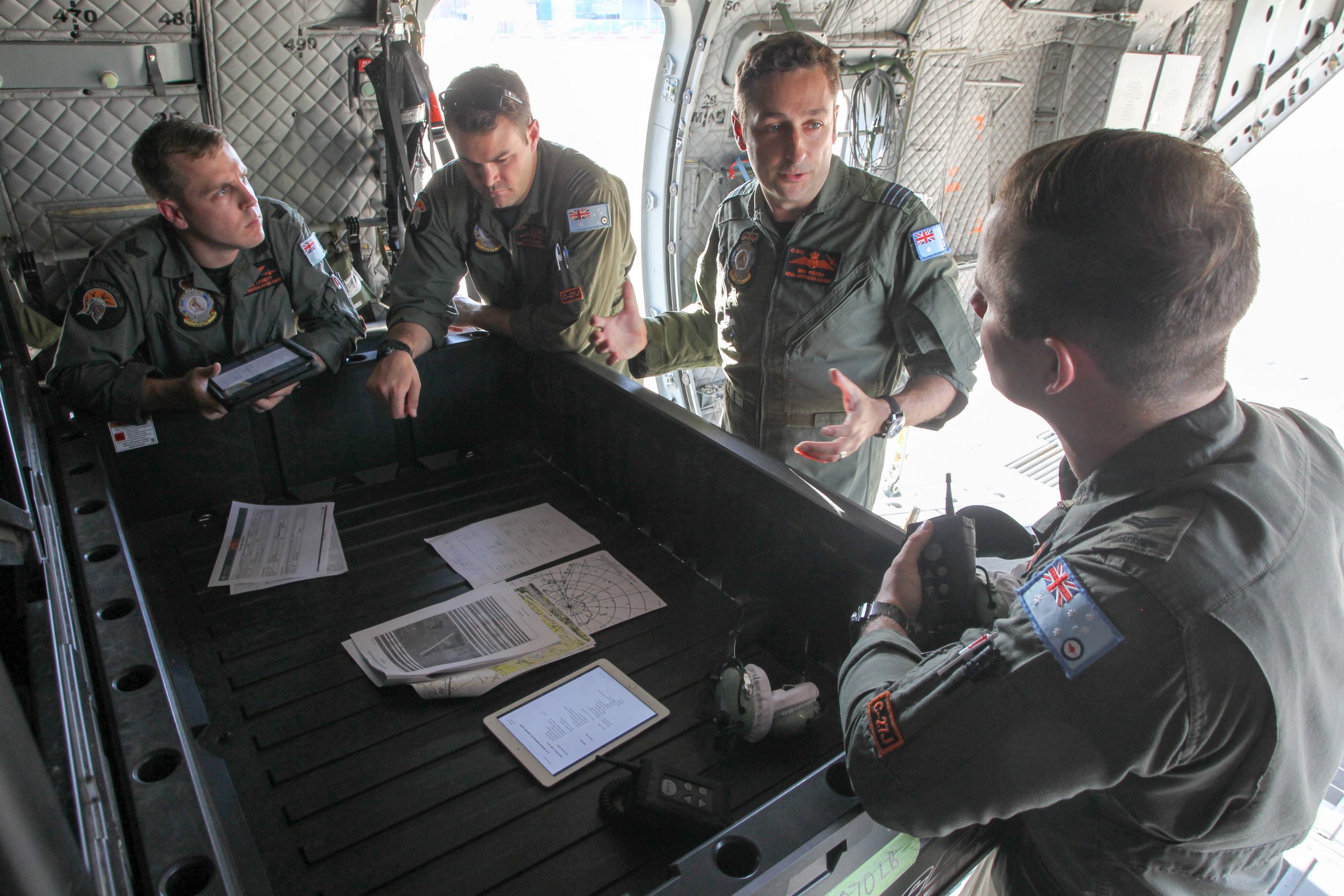
“For Exercise Hamel our objectives will be to provide a reliable and repeatable resupply of ammunition, food, and medical supplies into the field,” WGCDR Poxon explained. “The C-27J is the truck in the sky. We provide options to and land forces manoeuvre on the battlefield. This will allow commanders to consider the C-27J to insert or extract personnel and cargo rather than typical land manoeuvre.
‘We provide options to land manoeuvre forces on the battlefield.’
WGCDR Ben Poxon
“At Pitch Black we’ll be assessing our ability to integrate into a fifth-generation air force, whilst supporting the special operations community,” he added. “We will train in areas such as precision airdrop using GPS-guided chutes and dropping from quite high altitudes.”

The special operations support mission will be a key focus in 2019 in the lead-up to FOC, and will continue to be developed throughout the aircraft’s life of type.
“FOC will get us into a semi-permissive environment, akin to what we see in Iraq or Afghanistan. But with various avionics upgrades coming in the next two years, we would certainly be able to move into a higher threat environment in the coming years.”

HUB & SPOKE
“The type of aircraft and the capability each AMG aircraft brings adds a different slice to each capability set,” he explained. “If we talk about C-27J, specifically ‘how’ we will employ it is where it’s best capability is.
“If we employ this the same way as a C-130 or a C-17, we’d be doing it a disservice. This aircraft is more for intra-lift on the battlefield and our focus is in air-land integration closely aligned to the employment of the Chinook in a capability sense.”
WGCDR Poxon explained that C-130J or C-17 missions will typically sit on an air tasking order (ATO) generated by an air operations centre (AOC) that runs on a 72-hour cycle. This represents centralised command and decentralised execution.
But because the battlefield is a dynamic environment, the C-27J will operate in direct support of Army units alongside helicopters from a forward location so they can be quickly re-tasked if necessary. Therefore, the C-27J may be employed in a decentralised command framework.
“The C-27J has the ability to operate on a reduced battle rhythm of less than 24-hours,” WGCDR Poxon said. “So, our crews will plan with the people that actually conduct the tasking. This will provide more responsive, reactive tasking to our customers.
“Where the C-27J would take the mission instead of a Chinook, depends on the range from the base and what’s at the other end. The C-27J can go at least three to four times further, faster, and can carry more, but obviously we need a landing strip or something to land on. We provide a unique niche of capability between the C-130 and Chinook in this sense.”
With the C-27J sitting between the CH-47F and the C-130J, the wider ADF is also conscious of the need to support this hub-and-spoke concept, and has planned the building of cargo pallets so they can be offloaded from a larger aircraft to a smaller one without having to be broken down and re-built. While this may sometimes see the larger aircraft under-filled, the time-saving advantages in getting equipment to the forward bases and onwards into the field cannot be understated.
Part of integrating the C-27J into service has been the process of educating the aircraft’s customer base.
“One problem we have is that the C-27J was sold as a Caribou replacement, and to a certain extent that’s correct. It is a twin-engined, smaller, light tactical transporter. But the battlefield of today has changed,” WGCDR Poxon said.
“The C-27J is almost twice as heavy as the Caribou. What it does gain in the extra weight is range, it gets speed, it gets flexibility, but it also has defensive systems and comms that allow it to integrate on the modern battlefield.”
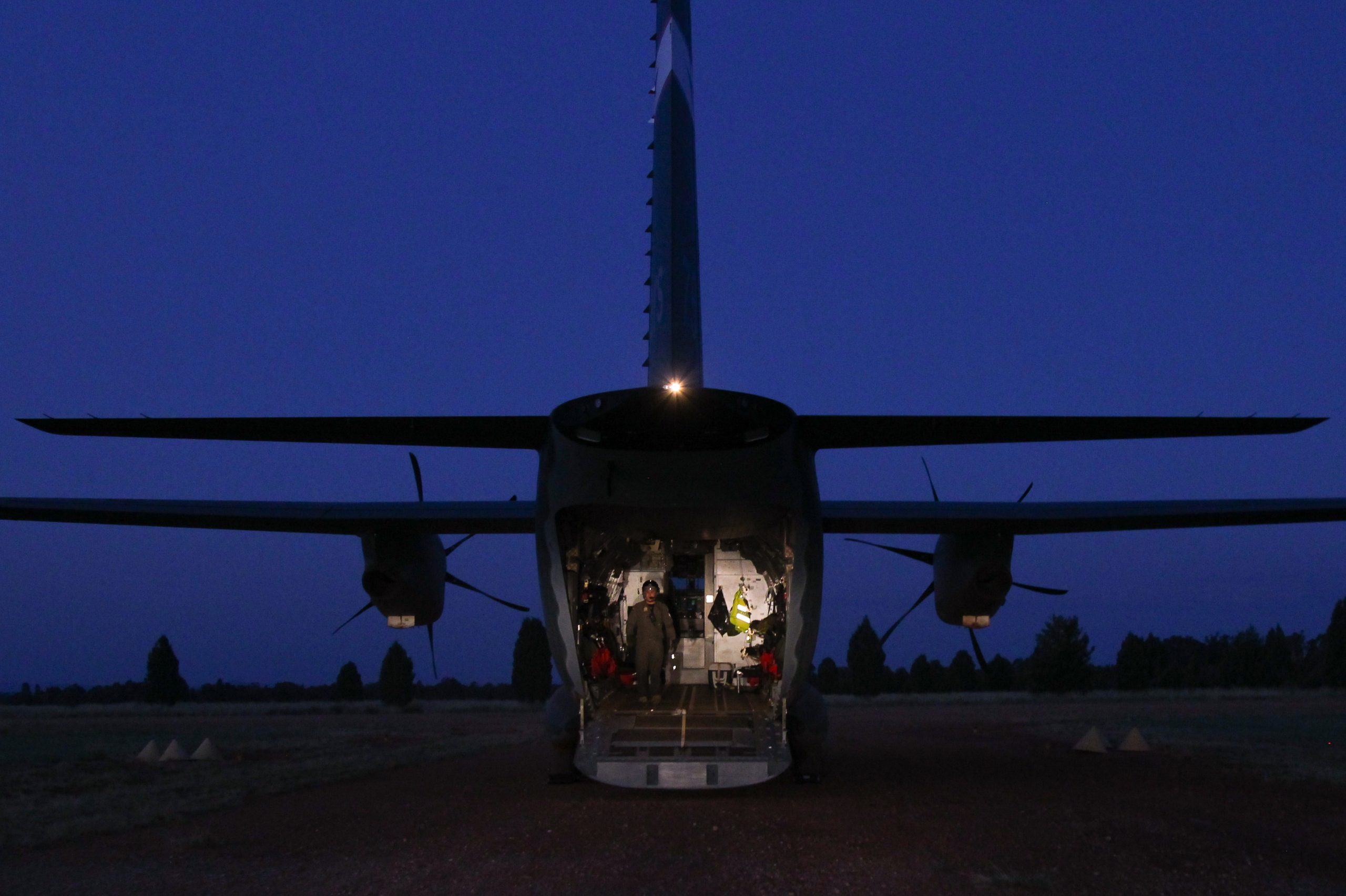
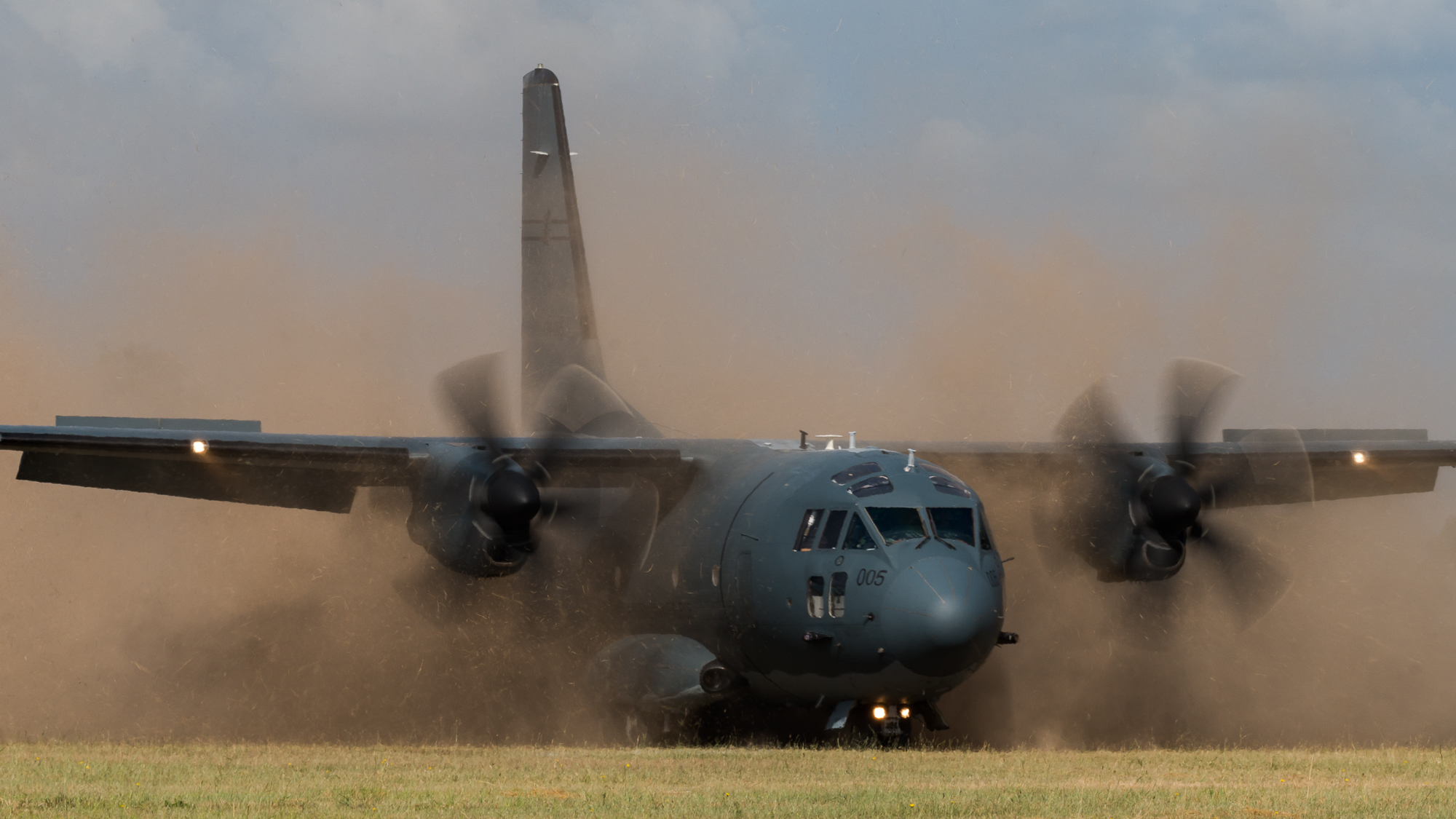
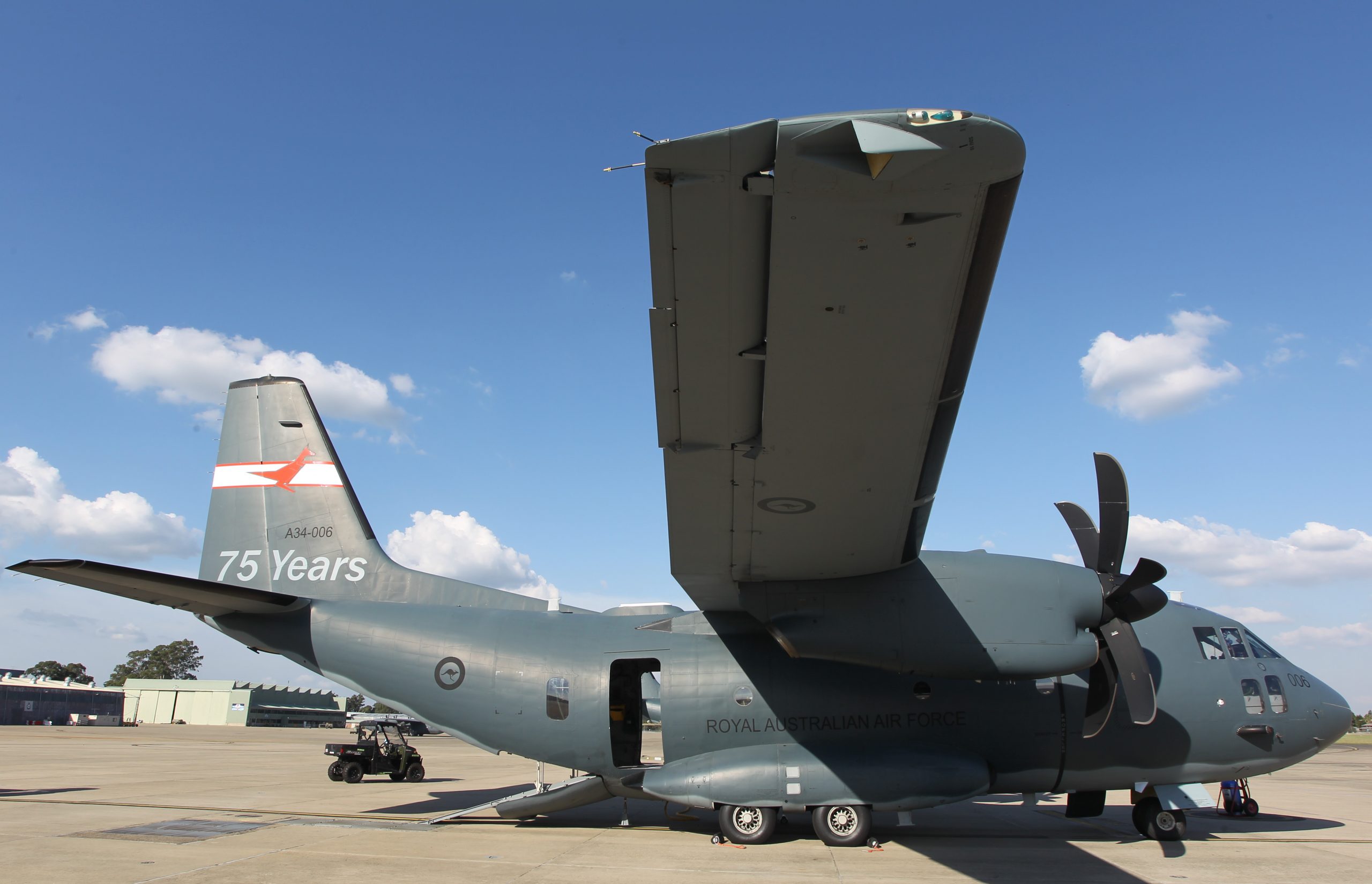
While the C-27J doesn’t have that much of a shorter landing roll or takeoff run than a C-130J, where it excels is in its ability to land on strips with a much lower pavement classification number (PCN), a rating used to indicate the strength of a runway, taxiway or ramp.
As a consequence, while the C-27J carries a lot less than the C-130, the RAAF claims it can access up to 1,900 airfields in Australia compared to about 500 for the C-130J.
“We’re very adept at small team insertions and extractions,” WGCDR Poxon said.
“That’s why when you look at this capability, special operations are very excited about it. Overall, AMG has increased the access to airlift with our 10 aircraft, but also, the C-27J is an aircraft that can go a long way with small teams and their gear.”
The RAAF C-27J’s are to receive an IFF mode 5 upgrade and ADS-B from later this year which will allow it to operate with restriction in international airspace. The first upgraded RAAF aircraft is currently in Italy being modified, and the rest of the fleet will be modified in Australia by RAAF and Leonardo technicians.
The C-27J airframe also features numerous currently blank antennae and apertures in anticipation of these being used for possible future communications and sensor additions.
“We’ve found it’s time consuming to change the structure of an aircraft,” WGCDR Poxon offered. “As soon as you start changing the outside of an aircraft, you’re talking about major modifications, therefore, we are looking at capabilities that roll on and roll off the aircraft.”
COMMONALITY
WGCDR Poxon said the C-27J’s commonality with the larger C-130J was already paying dividends for the RAAF.
“In general, one of the biggest advantages that we have had is the commonality with C-130J,” he said.
“One of the best decisions that we made was to have an aircraft with a similar engine. It’s been a proven engine over many years, and everything from the logistics to the contracts, to even the guys working on it has been a very simple transition.”
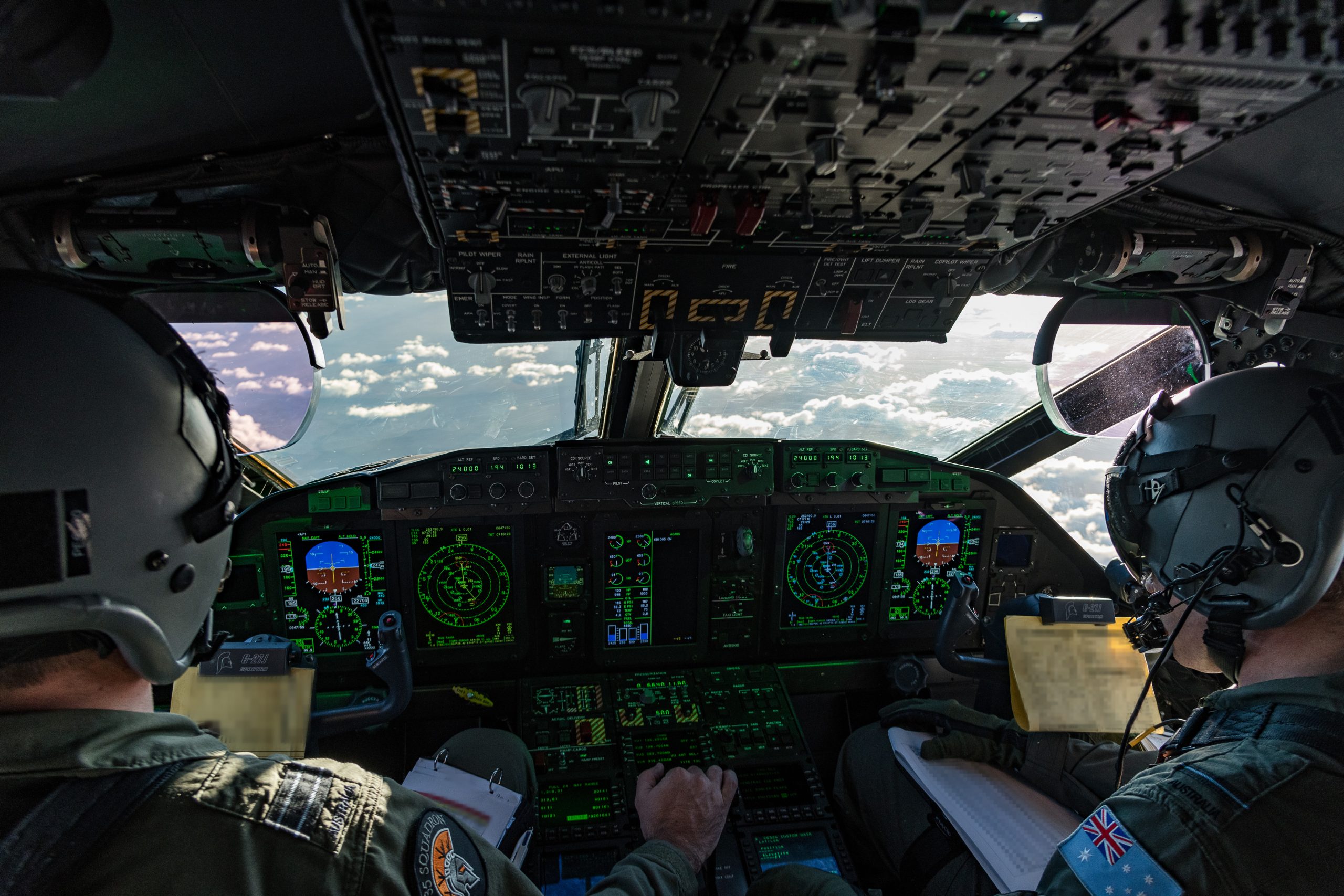
One of the key advantages is the ability for 35SQN to leverage the RAAF’s C-130J workforce to assist in supporting and training the C-27J maintenance workforce. Similarly, due to the similar cockpit layouts and mission planning systems, the training for a pilot transferring from the C-130J to the C-27J can focus more on the aircraft’s different handling characteristics and capabilities, rather than having to start from scratch.
“The avionics architecture is very similar as well. The CNI or the FMS is almost identical to a 2008/2009 C-130J, so I can bring a pilot from C-130J over to C-27J in six weeks, whereas it probably takes a good five months to train someone from the start or from another aircraft type,” WGCDR Poxon said.
“The roles are also very similar. Everything from intelligence products, to briefings, to how we conduct business for loadmasters down the back is almost identical. It’s a very good purchase from that point of view.
With his C-130J background, WGCDR Poxon said he felt at home straight away in the cockpit of the C-27J.
“Most of the systems avionics architecture, head-up displays, head-downs displays, are all taken from the C-130J. I passed a simple day-night check on the second simulator ride. In addition, I passed an instrument rating test after about seven sims.”
Being a smaller and lighter aircraft, the C-27J handles quite differently to the C-130J. In the tactical environment, pilots can stay lower for longer as the nimbler C-27J will get them into and out of valleys and over ridgelines much quicker. But the C-27J is more difficult to land as it sits on a narrower main undercarriage track and can dip on the nose and gets light on the mains when braking.
“If there’s any side movements whatsoever, you almost feel it’s a little bit tippy,” WGCDR Poxon explained.
“So, it is challenging on the runway and in higher crosswinds, but it’s just something that you have to get used to. Unlike the C-130J which is very solid during the landing ground roll, you’ve got to continue to fly this aircraft until you have stopped.”
The C-27J also has a higher thrust to weight rating, so it climbs very quickly.
“It’s got a lot of power behind it. Where we would typically put a C-130J’s nose up to 10 degrees for takeoff, we’re up around 17 or 18 degrees for takeoff for the C-27J.
“Even with a load, it’s still a bit of a rocket. But on one engine it’s challenging like any twin-engine aircraft on one would be. Whereas if you lose on engine on a C-130J you barely notice it. But in this aircraft, losing one engine is almost like losing two engines in a C-130J at the same time – it feels very slow to climb, and it requires quite adept handling skills.”
‘Even with a load, it’s still a bit of a rocket.’
WGCDR Poxon estimates the C-27J capability is a good five years ahead of where it would have otherwise been because of the commonality with its larger cousin.
“Both aircrew and maintenance that transition across to the aircraft bring a lot of knowledge with them,” he said
“35SQN conducts all of the maintenance on the aircraft. So, the men and women that are working on the aircraft and pulling it apart and are learning all the baseline skills that you would need to repair a battlefield airlifter in the field as well. We’re looking at trying to stand up the battlefield damage repair sometime soon – it’s something the RAAF has not focused on for a while.”
MAINTENANCE
Last November it was announced Northrop Grumman had been awarded a performance-based contract to maintain the RAAF’s C-27J fleet.
But unlike most industry-led sustainment contracts, Northrop Grumman doesn’t actually lay a finger on the aircraft itself. “They provide the engineering services,” 35SQN senior engineering officer (SENGO) SQNLDR Amanda Gosling Clarke said.
“They’re the platform steward for the aircraft, so they look after our documentation suites, configuration control, structural integrity, and the logistics pipeline.”
There is also a small team of Leonardo field service representatives (FSRs) who work through the Northrop Grumman contract, while engine maintenance is performed by Standard Aero. which also looks after the C-130J’s engines.
SQNLDR Gosling Clarke also came from C-130Js, and before that, the F-111.
“A lot of people think of C-27J as a mini Herc because it looks like one,” she said. “But realistically, it’s pretty far from that when you get into the maintenance of it. While it shares some systems, it’s definitely a different beast.
A lot of people think of C-27J as a mini Herc because it looks like one.’
SQNLDR Amanda Gosling Clark
“Because it’s from a smaller production line, it’s a handmade sort of aircraft. Its publications have a very different…philosophy, which has been interesting for our maintenance team to learn and to think about things in a different way than perhaps with Lockheed Martin maintenance publications.
“It’s been quite a journey for the maintenance team which has been here since we got the first aircraft, right up until now. They were here for the first wheel change, the first time we did everything. The first time we opened those pubs to go through a procedure.”
35SQN’s maintenance team has now performed three series of servicings on their aircraft, and performed its first engine change in April. The squadron is also being more efficient with its workforce, by cross-training maintenance personnel across multiple trades.
“There have been a lot of things that we don’t do on other air force platforms, because we’re doing the deeper maintenance level servicings as well as the operational servicings,” SQNLDR Gosling Clarke said.
“The squadron has been established with a ‘grey trader’ initiative in mind, so for any task that we can cross-trade or cross-train people, then we will.
“We’ve got ‘black handers’ pulling out avionics boxes, and we’ve got avionics guys helping on our brake changes. As you go up in complexity of the task, we just make sure that there’s a core trained person as the maintenance manager.”
The C-27J has a phased maintenance approach, where every part of the aircraft is serviced over a four-year cycle.
“It’s also based off of hours and landings. But that does enable us to increase the amount of time that we’ve got the aircraft online, because there’s lots of smaller maintenance opportunities to address other things that happen.”
As a consequence, the longest a C-27J will be out of service is about eight weeks, whereas a C-130J can be down for six or more months during a major service.
‘The longest a C-27J will be out of service for maintenance is about eight weeks.’
“It’s actually quite difficult to think about compared to the American system,” SQNLDR Gosling Clarke said.
“Especially if you are using some more basic fleet planning tools, which is what we’ve currently got available. We’re going to need to get a little more technical before we can make that program more efficient.”
According to the 2018/19 budget documents released on May 8, the RAAF’s C-27Js will fly about 4,000 hours in the year to June 30, increasing to 5,000 in 2018/19, and ultimately to 7,500 per year in 2019/20 and beyond as the squadron achieves FOC.
“I’d actually say that, one of the key benefits of setting up a new squadron like this and bringing people in from all over the place, is the diversity of our team,” SQNLDR Gosling Clarke said. “We’ve got such a diversity of backgrounds through our organisation, and there’s been some really innovative ideas coming from those places.
“We’ve got people from ACG, we’ve got our P-3 guys, we’ve got people coming from Hercs, C-17s, the lot, which is really good. And we have a really engaged chain of command that is willing to listen to those innovations and look at putting them in place, which is going to mean great things for the capability as it goes forward.”
TRAINING
While most of 35SQN’s pilots had come from other multi-engined types or via King Air, WGCDR Poxon said he was now getting more straight from 2FTS.
“Most of them have come from King Air and C-130J,” he said. “We’ll get a few from the P-3 through our transition. But then we’ll get 2FTS graduates to come through at the bottom.
“We actually need the 2FTS graduates to come through and do a typical co-pilot to captaincy tour. Until now we have focused quite heavily on the flying supervision side. But if you have too much experience, then you have a top-heavy squadron and risk progressing at a rate unachievable for 2FTS students.
“At the moment we are short on pilots,” he added. “But that’s not due to the availability of pilots, but more to do with getting the pilots through the training system to the C-27J.”
Pilots new to the C-27J who have come from a type other than a C-130J do a six-month initial qualification course, at the end of which they are able to conduct airborne operations missions competently. At least six weeks of that course is currently conducted at Pisa in Italy, but this will transition to Australia from 2024 when the C-27J simulator is installed and certified at Amberley.
PLTOFF Katherine Mitchell is one of 35SQN’s ‘bograt’ pilots who has come straight from 2FTS. “I came straight off pilot’s course in December last year,” she told ADBR. “We actually get posted out of 2 FTS on to any airframe in Defence now, the only one that they don’t post onto is the BBJ I think.
“So you can go straight from the PC-9 or the PC-21 onto Spartans, and there’s a couple from my course that went straight to Hercs as well,” she added. While the C-27J wasn’t PLTOFF Mitchell’s first airframe choice, she said it was “right up there.”
“That’s mostly because, for what this airframe’s going to do in the future, I think it’s quite an interesting outlook,” she said. “The flexibility we can do, get into places, and what the squadron’s going to eventually do with it is really interesting. So it was definitely up there in my preferences.”
PLTOFF Mitchell said she had already had some exposure to the C-27J when, while doing Officer Training School (OTS), she had an opportunity to deploy to East Sale in a C-27J as part of her training.
“We all had our packs on and our weapons and did a little mini-tac flight around the back of the Spartan, landed, and then deployed off the back for our field exercise,” she said. “I got that experience quite early on which for me was probably the best thing that could’ve happened, because it meant that I had this interest in this airframe from early on.”
During her time at 2FTS, her course also had a visit from AMG staff to brief them on the aircraft and what role it would play in the ADF. Going forward, she seems confident in the C-27J and in her abilities to progress on the aircraft.
“At the beginning of this year we went through ground school phase, then went over to Italy for five weeks for sim phase. There we did our basic instrument flying tests, a bit of basic tac and stuff. We’ve just started our first flying phase and have done a couple of flights, and we’re heading off on an (around Australia) ‘Aus-trainer’ in June or July.”
“I have more of an interest in working with a multi-crew than single pilot,” PLTOFF Mitchell added. “I find it more interesting having other people to throw ideas up against and having a crew to support you through the decisions that you make. I’m also quite interested in the humanitarian side of it as well, so obviously we have a big role there.”
From that point she will progress initially as a trainee co-pilot under the guidance of an experienced pilot, before being rated as a C-Cat co-pilot by the end of the year. From there, WGCDR Poxon says she should be able to achieve her captaincy on the aircraft in 2019.
As with all RAAF flying operations, C-27J pilots are given category ratings based on their proficiency. “D-Cat is safe operation of the aircraft, and a C-Cat is proficient, so you can employ that aircraft proficiently in a mission,” WGCDR Poxon explained.
“A B-CAT pilot is highly proficient so therefore your chances of mission success are increased, and that also aligns with a captaincy. Then A-Cat is ‘select’.”
LOADIES
No less important than the pilots are the C-27J’s loadmasters, and like the pilots, the ‘loadies’ have a mix of experience and backgrounds.
“We’ve got our first direct entry off the street loadmaster,” 35SQN’s Executive Loadmaster, WOFF Dave Pyatt told ADBR. “Traditionally it was a re-muster role, but Air Force has identified that we need to reach out further without taking a lot of the resources and corporate experience, and actually develop more.
“So we have eight ab-initios coming through,” he added. “This includes our Army Private who made the lateral transfer across and who, when he graduates this year, will be corporal loadmaster. We changed the rank from Sergeants down to Corporals so we can turn that top-heavy, warrant officer-centric workforce into one that is more merit-based.
‘We have eight abinitios coming through.’
WOFF Dave Pyatt
WOFF Pyatt’s own background is a diverse one. “I’ve been in the Air Force for 24 years, and a loadie for about 14,” he said. “I was on C-130Hs then C-17s for about 10 years, did a couple of ground jobs on an exchange posting with the US Air Force, and spent the past three years at RAAF SALT (the School of Administration and Logistics Training at Wagga Wagga) teaching air movers.”
WOFF Pyatt says the difference between the C-17 and C-27J is palpable for a loadie. “Absolutely, 18 pallets to 3 pallets is a big difference,” he said “I guess the C-27J aircraft is a lot nimbler and less forgiving in terms of attention to detail, whereas the C-17 has got a lot of fat, but it’s the same applied physics.
“I think the best thing about this aircraft is we can adapt and use innovation on the aircraft cable and cargo handling systems,” he added.
We switched to the Brooks & Perkins cargo handling system on the Hercs, but through the nature of the missions and the complexity and the weight saving we wanted to achieve, we ended up removing it. On the C-27J we can install it as required per mission, that gives us an extra half a ton of cargo or fuel or whatever else.”
AMG’s Air Movements Training and Development Unit (AMTDU) which is tasked to develop and certify the carriage and dropping of equipment aboard ADF aircraft has a 35SQN member posted as a liaison to the unit.
“We liaise with him and he bounces ideas, so we have that cross-pollination,” WOFF Pyatt explained. “We’ll rotate people through the posting cycle who have a particular appetite for that role, then they’ll come back to us with their expertise in engineering and airworthiness which bolsters up our experience.”
In summary, not only is the C-27J certainly a massive capability leap over the much-loved Caribou it has replaced in the BFA role, but the way in which the squadron and indeed, the wider RAAF is doing business is also new.
Despite some initial hiccups, the capability is now much further along the capability curve than many which have come before it, and the RAAF has put in place innovative and effective training, maintenance and sustainment programs to support it efficiently.
The Spartan looks set to be here for a long time.
Want to see more stories from trusted news sources?
Make Australian Aviation a preferred news source on Google.
Click here to add Australian Aviation as a preferred news source.




