
 iscover
RT
 0 comment


Rotor Torque
The global H145 fleet has achieved more than 100,000 flight hours since entry into service in 2015. airbus helicopters
NSW POLICE ADDS THREE NEW AIRCRAFT TO FLEET
The NSW Police Force Aviation Support Branch has commissioned three new aircraft into operational service.
This content is available exclusively to Australian Aviation members.
A monthly membership is only $5.99 or save with our annual plans.
- Australian Aviation quarterly print & digital magazines
- Access to In Focus reports every month on our website
- Unlimited access to all Australian Aviation digital content
- Access to the Australian Aviation app
- Australian Aviation quarterly print & digital magazines
- Access to In Focus reports every month on our website
- Access to our Behind the Lens photo galleries and other exclusive content
- Daily news updates via our email bulletin
The three aircraft comprise PolAir 2, a twin-engine Bell 412EPI, as well as two Cessna Grand Caravan EX fixed-wing turboprops, callsigns PolAir 6 and PolAir 8.
NSW Police Commissioner Mick Fuller said the state-of-the-art-aircraft would strengthen the Force’s ability to respond to, target, disrupt and prevent crime.
“The addition of these aircraft ensures the NSW Police Force remains at the forefront of aerial law enforcement, while continuing to provide support to police and communities right across the state,” Commissioner Fuller said in a statement.
“The PolAir fleet provides invaluable support across the organisation from assisting during search and rescue missions, maintaining a bird’s eye view on criminals, or conducting major crime investigations and operations.
The official commissioning ceremony, attended by NSW Governor David Hurley, NSW Police Minister Troy Grant and invited guests, was held on April 10 at the NSW Police Force’s Aviation Support Branch base at Bankstown Airport.
The Bell 412EPI is an upgrade of the venerable Bell 412 and features improved, FADEC-equipped engines and Bell’s BasiX Pro avionics system, including four 10.4in LCD screens.
“PolAir 2 brings superior capabilities that will assist NSW Police with day-to-day operations and with advanced ‘auto hover’ autopilot technology, will be used during winch rescues, particularly near cliffs or over water,” NSW Police said.
Meanwhile, the EX is the latest variant of Cessna’s popular Grand Caravan EX fixed-wing single-engine turboprop.
“The fixed-wing aircraft are fitted with digital glass cockpits for improved safety in flight, as well as large windows allowing a wide field of view to assist during searches of both land and waterways,” NSW Police said.
“In addition, the fixed-wings have heavy lift capability to allow for the transport of cargo, specialist equipment and personnel during extensive search and rescue incidents.
The addition of the Bell 412 and Caravans brings to eight the total number of aircraft in the NSW Police Aviation Fleet, with the trio joining PolAir 1, (an AS350 B2 Squirrel), PolAir 3, (also an AS350 B2), PolAir 4 (an EC135 P2e), PolAir 5 (also a Bell 412 EPI) and PolAir 7 (also a Cessna Grand Caravan EX).
It is the largest fleet of police aircraft in Australia.”
BABCOCK APPOINTS NEW SENIOR LEADERSHIP
Babcock Australasia has split its aviation business into two separate operating units, ‘Mission Critical Services Australasia’ and ‘Offshore Services Australia’.
The restructure follows a review of the company’s operations in Australia led by local chief executive David Ruff.
“Establishing separate Onshore and Offshore businesses led by dedicated management teams recognises the differences between those businesses’ customer bases, as well as the different operating environments,” Ruff said.
As part of the restructure, Lauren Adams has been appointed as managing director, aviation onshore, while Andrew Cridland has been appointment as managing director, aviation offshore.
Babcock’s onshore division provides EMS and SAR services to state government bodies including Ambulance Victoria, the South Australia state government, RACQ Central Queensland Rescue Service, RACQ Capricorn Helicopter Rescue Service and Queensland Health, while its offshore customers in the oil and gas sector include PTTEP Australasia, Woodside Energy, Chevron and ConocoPhillips Australia.
“Babcock’s aviation businesses operate across very demanding and diverse environments, delivering vital services to the exacting standards demanded by our Regulators and our discerning customers,” Ruff said.
One of those “discerning customers” is Conoco Phillips, which has presented Babcock Offshore Services Australasia with a ‘focus on execution award’ for Babcock’s introduction into service of the Airbus Helicopters H175 in support of ConocoPhillip’s Bayu-Undan gas production facilities in the Timor Sea.
“A smooth transition was particularly important; as this was the first time Babcock’s new Airbus H175 helicopter would be used in the southern hemisphere,” Babcock said.
“In addition to meeting delivery dates and training pilots and mechanics on the new aircraft, Babcock collaborated with ConocoPhillips to build a new helicopter base in Dili, Timor-Leste in only nine months.”
ATSB RELEASES EC135 CRASH INVESTIGATION REPORT
The Australian Transport Safety Bureau (ATSB) says that Australian landscape and nature photographer Richard Green, his wife Carolyn and friend John Davis were killed when Green’s Airbus Helicopters EC135, VH-GKK, collided with terrain in November 2015 due to flying in “marginal” weather conditions while operating under visual flight rules.
“The ATSB found that the pilot departed an interim landing site under the visual flight rules in marginal weather conditions. The pilot likely encountered reduced visibility conditions leading to loss of visual reference leading to the collision with terrain,” the ATSB’s final report into the November 7 2015 accident found.
The EC135 had been on a flight from Breeza, near Tamworth in New South Wales to Terrey Hills in Sydney’s north, and diverted from its direct track “probably” after encountering bad weather, the ATSB found.
“Witnesses in the Laguna area observed the helicopter overfly the Watagan Creek valley in the direction of higher terrain. The helicopter was then observed to return and land in a cleared area in the valley,” the report, released in late April, reads.
“After 40 minutes on the ground, the pilot departed to the east towards rising terrain in marginal weather conditions. About seven minutes later and approximately 9km east of the interim landing site, the helicopter collided with terrain.”
A search and rescue mission for the EC135 and its occupants was not launched until 36 hours later as relatives were not necessarily expecting the helicopter to return to Terrey Hills that evening. The ATSB noted that the pilot had not logged a SARTIME (search and rescue time) with Airservices Australia, nor left a flight note with a nominated other.
The investigation also found that the EC135’s fixed airframe-mounted ELT had been removed “and that personal locator beacons which required manual activation were carried instead. While in this accident it did not affect the outcome for the occupants, the lack of activation, combined with the absence of flight notification information, delayed the search and rescue response.”
As for safety messages from the accident, the ATSB observed that, “Pressing on into IMC conditions without a current instrument rating carries a significant risk of encountering reduced visual cues leading to disorientation. This can easily affect any pilot, no matter what their level of experience. In the event of inadvertent entry into IMC, pilots are encouraged to contact air traffic control for assistance.”
Green had over 2,650 hours of flight time in his logbook, but had never held an instrument rating. He was issued a Night VFR Helicopter endorsement in 1992, but “did not appear to meet the night-VFR recency requirements.” The report also notes that Green was investigated by CASA over three separate incidents, which took place in August 2006 and May and November 2012, and that CASA suspended his licence in 2013 (it was reinstated the following year).
LEONARDO OVERHAUL MRH90 GEARBOXES IN NEW MELBOURNE FACILITY
Leonardo is to establish a helicopter transmission repair facility in Melbourne thanks to a $16 million co-investment from the federal government.
The facility, to be operational by mid-2020, will overhaul the main gearboxes of the ADF’s 47 MRH90 Taipans, with the government’s investment set to be repaid over the remaining life of type of the helicopter thanks to reduced sustainment costs. Leonardo says it is investing “a similar amount” in the new workshop, which will be co-located with an existing Leonardo facility at Essendon Airport and will employ “at least 12 technical staff for 30 years or more”.
The new centre will also be capable of overhauling the gearboxes of foreign NH90s and gearboxes of civilian AgustaWestland AW139 helicopters.
“Establishing this repair and overhaul facility locally means less reliance on foreign support for our MRH Taipan helicopters, and the same for certain local civil helicopter operators,” Minister for Defence Industry Christopher Pyne said in late April.
“This project is a true win-win situation for both Defence and local Defence Industry. It creates more Defence Industry jobs in Victoria and will lead to greater helicopter availability for operations.”
Leonardo designed and manufactured the gearbox and transmission components for all NH90 series helicopters, including the MRH90. The company has just under a one-third share in the NH90 program. It operates an NH90 final assembly line in Cascina Costa, Italy and as well as the transmission and gearbox is responsible for the design and production of the helicopter’s rear fuselage, hydraulics and automatic flight control system.
EAGLE DELIVERES SECOND 407HP
Coffs Harbour-based Eagle Australia has delivered its second conversion of a Bell 407 helicopter to the 407HP configuration, where the standard Rolls-Royce 250-C47 turbine is replaced with a Honeywell HTS800, which substantially improves the type’s high altitude and hot ambient performance.
The upgraded machine is now being operated by Heli SGI, which operates in West Papua, Indonesia, and Papua New Guinea. “When put to work on a drilling exploration contract in Papua New Guinea the aircraft returned a 30 to 50 per cent net increase across all loads with which it was tasked,” Eagle says.
“As well as lifting heavier loads, the 407HP could carry more fuel than a standard 407 when burdened with a similar load, and close to double the load of a standard 407 at 11,300ft (with a density altitude of 13,000ft).”
ATSB HIGHLIGHTS IMPORTANCE OF UNDERWATER ESCAPE TRAINING AFTER EC135 CRASH
A pilot who died in an accident off the West Australian coast in March had not completed a helicopter underwater escape training (HUET) course in more than nine years, the ATSB has found.
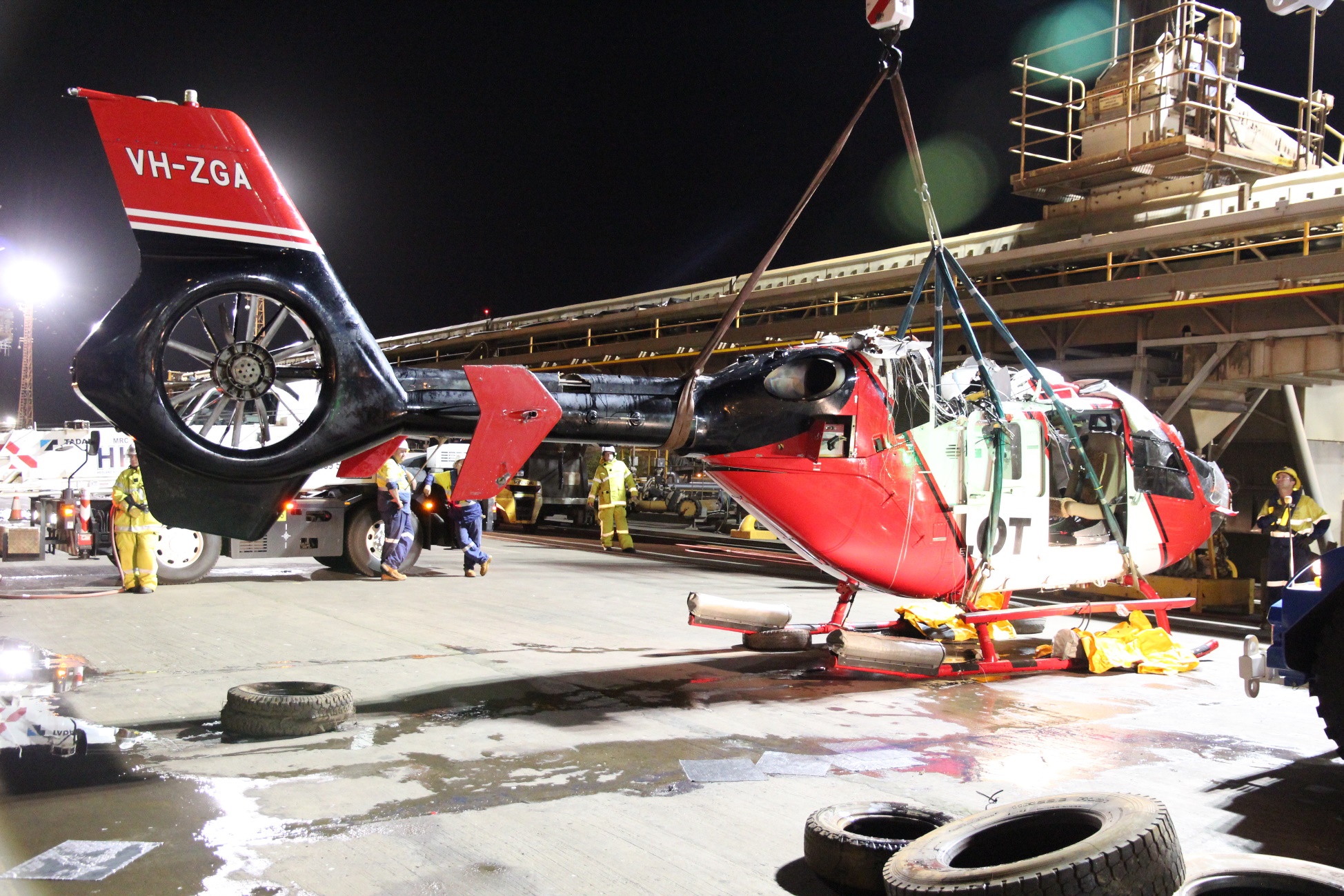
The accident took place on March 14, when Eurocopter EC135 P2+ VH-ZGA crashed off the coast of Port Hedland in Western Australia, killing one of the two pilots on board. (Eurocopter was renamed Airbus Helicopters in 2014.)
The EC135, operated by Heli-Aust Whitsundays, was en route from the Port Hedland helipad to a bulk carrier ship to collect a marine pilot back to Port Hedland.
“What we have found so far is that the helicopter was on approach to collect a marine pilot from a vessel at night and collided with the water. The helicopter then rolled inverted before floating for a short time before sinking. The first pilot was able to escape the wreckage, however the second pilot was unable to free himself from the wreckage prior to the helicopter sinking,” Nat Nagy, the ATSB’s executive director, transport safety said.
“Our examination of the operator’s records indicate that the deceased pilot, who was new to the company, had not undertaken any helicopter underwater escape training for the past nine years. It is vital for all pilots who undertake over water operations to regularly conduct under water escape training to greatly increase their chances of survival in an accident such as this.”
The ATSB preliminary report, published on May 3, said the pilot under check who died in the incident last completed his HUET in February 2009, which was “outside the operator’s three-year recurrent training period”.
“In light of our initial investigation, the ATSB has contacted all helicopter operators that are involved in over water operations to deliver a safety advisory notice. The ATSB strongly recommends that aircrew and regular passengers on these sorts of operations receive training in under water escape to increase survivability in the event of a ditching such as this one,” Nagy said. A final report is expected in the first quarter of 2019.
AVIATION AUSTRALIA LAUNCHES RPAS COURSE
Brisbane-based training organisation Aviation Australia in partnership with Remote Aviation Australia is set to deliver a Remotely Piloted Aircraft Systems (RPAS) course.
‘It is vital for all pilots who undertake over water operations to regularly conduct under escape training.’
Those who successfully complete the Certificate III in Aviation (Remote Pilot – Visual Line of Sight) course would qualify for a Remote Pilots Licence (RePL), which allows for the use of RPAS for business or commercial purposes under approved weight and operating restrictions.
They will also receive an Aeronautical Radio Operators Certificate (AROC), which is a Civil Aviation Safety Authority (CASA) requirement to use aviation radio frequencies.
Aviation Australia and Remote Aviation Australia said the course was developed in response to the growing use of RPAS, which are also known as drones, for work and commercial purposes in industries such as emergency services, the police service, research collection and surveying.
“RPAS are already being used as a business tool to access high, difficult or unsafe places,” Remote Aviation Australia chief remote pilot Ryan McMahon said.
“As a result, many sectors are ramping up their usage, using them for disaster management, infrastructure, agriculture, surveillance and resource purposes.”
The first course was due to commence in late May.
AUSTRALIA TO TRIAL HELICOPTER FATIGUE TESTING TECH ON AN EX US NAVY SEAHAWK
The US Navy has supplied a retired Seahawk helicopter for Australian Defence scientists to develop and test new fatigue testing technologies which, if successful, could significantly reduce maintenance costs and improve aircraft availability.
“In a world first, Defence scientists and engineers are developing a fullscale, structural fatigue test rig that can accurately replicate the loads and forces experienced by a helicopter in flight,” Minster for Defence Industry Christopher Pyne said in a statement.
“While full-scale fatigue tests are routinely conducted for fixed-wing aircraft, the complex, high-frequency flight loading of helicopters has been particularly challenging to replicate in the laboratory. Instead, helicopters are certified using conservative test methods that do not always fully predict the possibility of fleet damage.”
The Minister said Defence was investing $5 million on the project, which involves Australian companies Nova Systems, Jack Thompson Engineering, Fortburn and Advanced VTOL.
“The trial program, including the building of the innovative test rig and test demonstration, commenced late last year and will continue until 2022,” the Minister said.
“The program aims not only to develop the capability to fully test and validate helicopter structures, but also to deliver innovations that may be applied to other areas such as the fatigue testing of fixed-wing aircraft.”
The US Navy has expressed an interest in applying the new technology across its entire Seahawk fleet in the future.
WHITSUNDAY EC120 ACCIDENT INVESTIGATION UNDERWAY
The ATSB is investigating the crash of a Whitsunday Air Service Eurocopter EC120 B as it was approaching to land on a pontoon at the Hardy Reef floating helicopter landing site in the Great Barrier Reef Marine Park near Hamilton Island on March 21.
Two of the four passengers onboard the EC120, registered VH-WII, died in the accident. The two other passengers sustained minor injuries while the pilot was uninjured.
“While approaching the pontoon, at about 1535, the pilot reported noticing a warning message illuminate in the upper vehicle and engine multifunction display,” the ATSB’s preliminary factual report into the accident, released on April 18, reads.
“As this was a high workload phase of flight, the pilot was unable to verify the nature of the warning. However, in response, the pilot elected to conduct a go-around. When the helicopter was at an altitude of about 40ft (12m) above the pontoon, the pilot recalled feeling a ‘thud’ and the nose of the helicopter yawed sharply left (anticlockwise from above).
“In an attempt to arrest the yaw, the pilot reported that he made a number of control inputs, which included lowering the collective and pushing the cyclic forward and to the left. The pilot was unable to regain control of the helicopter and it collided with the water.”
The pilot and two of the passengers were able to free themselves of the upturned helicopter and swim clear.
“The remaining rear passenger was evacuated by one of the surviving passengers and the front passenger (in the copilot seat) was evacuated from the helicopter by the pilot,” the ATSB noted.
After an underwater survey using a remotely operated vehicle to determine the location of the EC120’s wreckage, the ATSB said it may consider recovering the wreckage “for inspection and recovery of the recorded information”.
The investigator says its final report into the accident should be released in the first quarter of 2019.
AIRBUS & SCHIEBEL TEST MANNED-UNMANNED HELICOPTER TEAMING
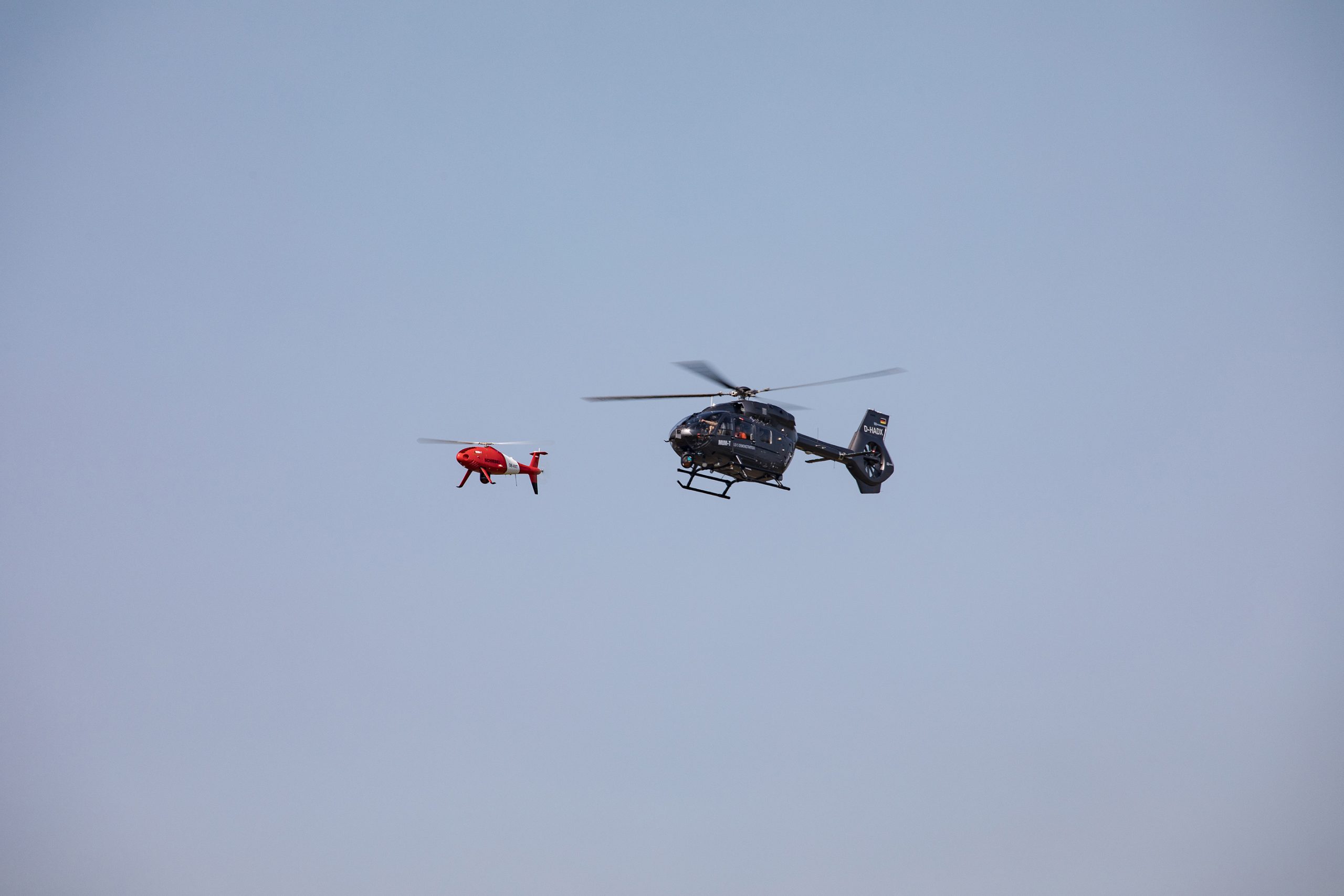
Airbus Helicopters and Schiebel have conducted manned-unmanned teaming (MUM-T) testing between a manned Airbus H145 and an unmanned Schiebel S-100.
Conducted with the support of the Austrian Armaments and Defence Technology Agency, the two aircraft flew a number of different scenarios including the detection of objects hidden in places not accessible by larger manned helicopters. The tests were flown using the highest level of interoperability (LOI), LOI-5 which allowed the S-100 to be fully controlled and piloted by an operator in the H145.
“Manned-Unmanned Teaming multiplies the capabilities of both systems”, Mark Henning, program manager at Airbus Helicopters said.
“Smaller UAS with vertical takeoff and landing capabilities can, for example, fly around obstacles such as trees or buildings closer than a helicopter could. They are able to explore unknown territory and deliver information to the helicopter crew which is operating from a safe position and which can then step in with the helicopter’s superior effects, having received a clear picture from the UAS.
Want to see more stories from trusted news sources?
Make Australian Aviation a preferred news source on Google.
Click here to add Australian Aviation as a preferred news source.




